
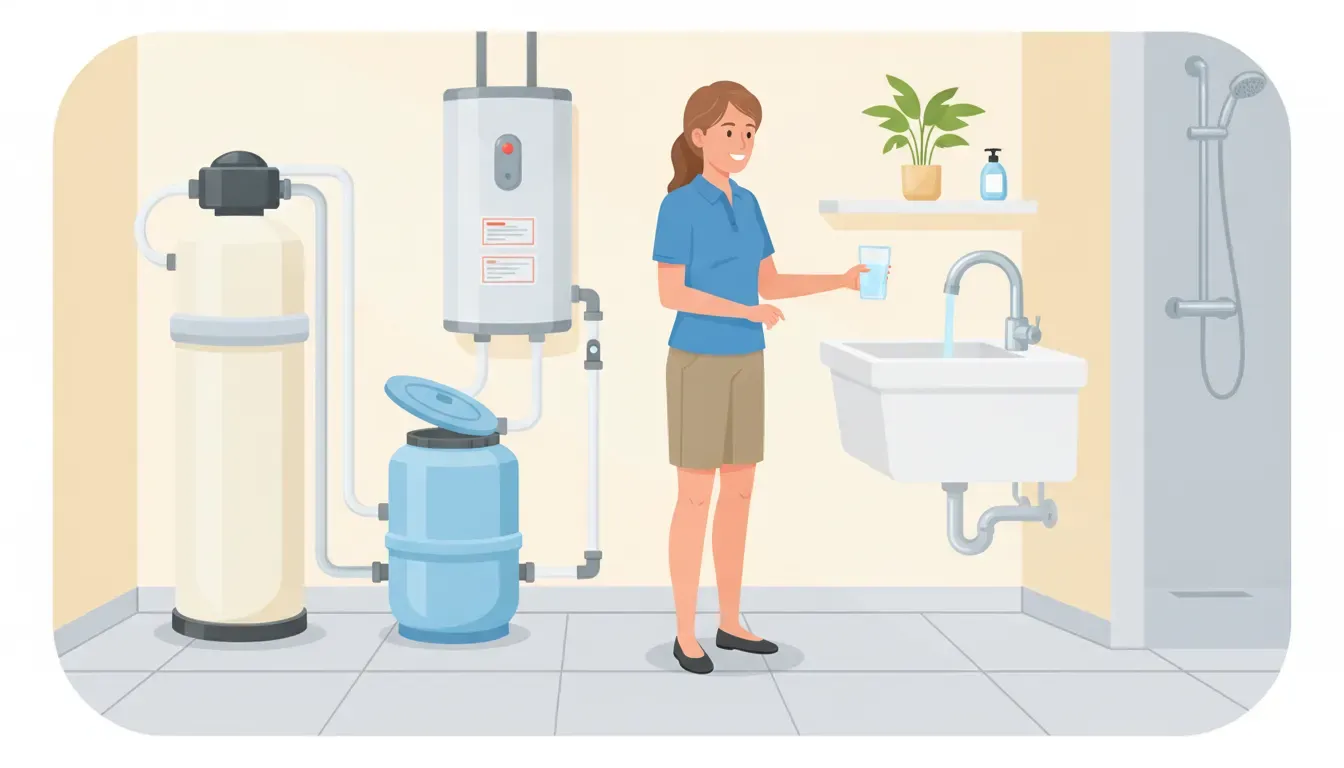
Water softeners help homeowners manage hard water before it leaves scale on fixtures, appliances, dishes, and laundry. The right system can make daily cleaning easier and reduce mineral stress on plumbing. Yet not every home needs the same treatment. Water hardness, household demand, plumbing layout, and water-quality goals should guide the decision.
This guide explains what water softeners do, how the main approaches differ, and which signs deserve professional attention. It focuses on practical selection and ownership questions. It does not replace a water test or an on-site plumbing evaluation.
Ask Miranda about water softening options for your home.
What Are Water Softeners?
Water softeners are treatment systems designed to reduce the effects of hard water. Hard water contains dissolved calcium and magnesium. These minerals can form scale on plumbing fixtures and inside water-using appliances.
Hard water is not automatically unsafe to drink. It is mainly a household performance and maintenance concern. It can make soap harder to rinse, leave spots on glass, and create a rough film on shower surfaces.
Water softeners are different from drinking-water filters. A softener targets hardness minerals. A filter targets specific particles, chemicals, tastes, or odors. Some homes need one approach. Other homes need several treatment stages.
The U.S. Environmental Protection Agency explains that cation-exchange softeners remove calcium and magnesium by exchanging them for sodium or potassium ions. Read the EPA overview of cation-exchange softeners for the technical foundation.
How Do Water Softeners Help With Hard Water?
Most traditional softeners use a mineral tank filled with resin beads. Hard water passes through the tank. The resin captures hardness minerals and releases sodium or potassium.
That simple exchange changes the water's behavior. It can reduce the mineral residue that makes cleaning frustrating. It can also reduce scale formation in parts of the plumbing system.
The resin eventually needs to be restored. The system enters a regeneration cycle that flushes away collected minerals. Salt-based systems use a brine tank during this cycle.
Regeneration makes system settings important. An oversized or poorly programmed unit may use more water and salt than necessary. Demand-initiated controls can help the system regenerate when treatment capacity is actually used.
The EPA notes that water and salt efficiency depend on proper selection, operation, and maintenance. Review the EPA WaterSense softener guide before comparing equipment.
Which Water Softener Approach Fits a Home?
Water treatment terms can be confusing. Some products remove hardness minerals. Others reduce scale without removing those minerals. Filters solve different water-quality problems.
The best choice starts with the problem you want to solve. A water test can show whether hardness is present and how severe it is. A plumbing professional can also review flow, space, drainage, and household demand.
| Approach | Main purpose | Key ownership question |
|---|---|---|
| Salt-based ion exchange | Removes calcium and magnesium from the treated water | Can the home support salt handling, regeneration, and discharge? |
| Salt-free conditioner | Reduces scale formation without traditional mineral removal | Does the homeowner want scale control rather than softened water? |
| Point-of-use filter | Targets selected drinking-water concerns at one fixture | Is the concern limited to taste, odor, or a specific contaminant? |
| Whole-house filtration | Treats water entering multiple fixtures | Which water-quality issue should the media address? |
Salt-based ion-exchange systems
Traditional salt-based systems are the standard option when a homeowner wants to remove hardness minerals. They can support softer-feeling water throughout the home. They also require a brine tank, salt, regeneration, and suitable drainage.
These systems need room for equipment. They also need a clear plan for salt replenishment. Homeowners should review local discharge rules and household preferences before installation.
Efficient controls matter. Look for a system sized for the household. Ask how the unit measures water use. Ask how it limits unnecessary regeneration.
Salt-free water conditioners
Salt-free conditioners are often marketed as water softeners. The distinction matters. Many conditioners do not remove calcium and magnesium from the water.
Instead, they aim to reduce the way minerals attach to surfaces. This approach may help with scale. It does not create the same type of softened water produced by ion exchange.
The University of Nebraska Extension describes salt-free devices as descalants rather than hardness-removing systems. Read the extension guide to salt-free options before relying on product claims.
A conditioner may suit a home that wants less scale without salt handling. It may not suit a homeowner who wants lower hardness for laundry, bathing, or specific equipment needs.
Filters and whole-house treatment
Filters and softeners solve different problems. A carbon filter may improve taste or odor. A sediment filter may capture suspended particles. A reverse-osmosis system may serve a specific drinking-water goal.
Do not choose a filter because the word softener appears in the product name. First identify the concern. Then match the treatment method to a tested water-quality result.
Miranda's water filtration installation service can help homeowners evaluate whole-house treatment options. Its plumbing services team can also review related plumbing conditions.
Contact Miranda for a practical water-quality and plumbing assessment.
Does Softer Water Mean Cleaner Drinking Water?
Not necessarily. Softening and filtration address different water-quality goals. A softener targets hardness minerals. It does not guarantee removal of every contaminant.
Homeowners should separate comfort concerns from drinking-water concerns. Scale on a showerhead points toward hardness. A taste or odor concern may point toward filtration. A test can reveal whether both concerns exist.
The EPA recommends identifying treatment goals before choosing a home water-treatment system. Its guidance also explains how public water reports and certified testing can inform that decision. Review the EPA water-treatment selection guide for a broader framework.
This distinction prevents an expensive mismatch. A softener may not solve a problem that belongs to a drinking-water filter. A small point-of-use filter may not address scale throughout the home.
How Do Local Water Conditions Affect the Choice?
Water conditions can vary between homes, neighborhoods, and supply types. Public water, private wells, pipe materials, and household plumbing can all change what a homeowner notices.
Treasure Coast homeowners should consider the full plumbing system. A water softener must fit the available space, flow, drainage, and service access. It should also match the home's actual water demand.
Local experience can make the evaluation more useful. A technician can look beyond one stained fixture. They can connect water-test results with scale patterns, appliance concerns, and plumbing layout.
That review also helps protect against over-treatment. The largest system is not automatically the best system. The most expensive product is not automatically the right match.
What Should You Check Before Choosing a Water Softener?
One sign does not prove that a softener is needed. Several repeated signs can justify testing and professional advice.
- White scale appears on faucets, showerheads, kettles, or glassware.
- Soap leaves a film even after thorough rinsing.
- Shampoo and soap seem difficult to lather.
- Clothes feel stiff or look dull after washing.
- Water spots return soon after fixtures are cleaned.
- A water heater shows mineral buildup during service.
- Dishwasher or washing-machine performance changes over time.
- Household members notice dry-feeling skin or hair after bathing.
These signs can have other causes. Cleaning products, fixture age, water temperature, and plumbing condition can produce similar symptoms. A water test creates a better starting point.
Florida homeowners can also see different water conditions from one neighborhood to another. Public supply, private wells, pipe materials, and household plumbing all affect the experience at a fixture.
Miranda's hard-water plumbing guide provides related context. A professional can connect visible scale with the actual condition of the home's plumbing and appliances.
How Should Homeowners Maintain a Water Softener?
Maintenance protects performance and helps prevent avoidable waste. The exact schedule depends on the model, water hardness, household size, and water use.
- Check the salt level on a regular schedule.
- Use only the salt or potassium product approved for the unit.
- Keep the brine tank area clean and accessible.
- Confirm that the bypass valve is in the correct position.
- Check the system clock after a power outage.
- Watch for leaks around connections and drain lines.
- Review regeneration settings after changes in household use.
- Follow the manufacturer's cleaning and service instructions.
Salt is not the only maintenance concern. A clogged injector, blocked drain, failing valve, or exhausted resin bed can affect results. Low pressure can also change how a system performs.
Do not ignore a unit that regenerates too often. Frequent cycles can increase water and salt use. A unit that never regenerates may leave the home with untreated water.
When Should You Ask a Professional About Water Softeners?
Professional help is useful before purchase, during installation, and when treatment results change.
Before choosing a system
Ask for a water-quality review before selecting equipment. The review should identify hardness and any separate taste, odor, sediment, or contaminant concern.
Ask how much treated water the home uses. Ask where the system can be installed. Ask how regeneration water will drain. Ask how future maintenance will be handled.
During installation
Installation requires more than placing two tanks beside a water line. The system may need a bypass, drain connection, electrical power, and correct plumbing integration.
Improper connections can cause leaks or leave some fixtures untreated. A professional can also confirm that the selected capacity matches the home's demand.
When the system stops performing
Call for help when water feels hard again, scale returns, salt disappears unusually fast, or the unit leaks. Error codes and unusual regeneration sounds also deserve attention.
Do not keep changing settings without understanding the cause. Incorrect settings can hide a mechanical problem or increase operating waste.
What Should You Check Before Choosing a Water Softener?
- Define the goal. Decide whether you want mineral removal, scale control, taste improvement, or another result.
- Test the water. Use reliable results instead of guessing from one fixture or one cleaning problem.
- Review household demand. Consider the number of residents, bathrooms, appliances, and typical water use.
- Inspect the installation area. Check space, access, drainage, power, and the existing plumbing layout.
- Compare ownership needs. Include salt handling, filter changes, service visits, regeneration, and discharge.
- Ask about verification. Confirm what the installer will test after the work is complete.
Product labels can sound similar while the treatment results differ. A clear goal keeps the purchase focused. It also makes it easier to compare professional recommendations.
For Treasure Coast homeowners, local plumbing conditions can influence the best setup. Miranda can review water treatment and related plumbing needs through its plumbing services department.
Get professional guidance before you choose a water softener.
Water Softener FAQs
Are water softeners the same as water filters?
No. Softeners address hardness minerals. Filters address specific particles, tastes, odors, or contaminants. Some homes need both systems.
Do water softeners remove every contaminant?
No. A softener is not a universal water-treatment system. Test the water and choose equipment for the specific concern.
Can a salt-free conditioner soften water?
Many salt-free conditioners reduce scale without removing hardness minerals. Ask what the equipment is certified to do before buying it.
How often should a water softener be serviced?
Service timing varies by model, water quality, household demand, and performance. Follow the manufacturer's guidance and request help when results change.
Can hard water damage plumbing appliances?
Mineral scale can build up on fixtures and inside water-using equipment. The level of impact depends on hardness, temperature, flow, and equipment condition.
Should I install a water softener myself?
A professional installation can confirm sizing, drainage, bypass operation, and fixture coverage. It can also reduce the risk of leaks or incorrect settings.
Talk with Miranda about the right water treatment approach for your home.