
Tankless Heater vs Tank: Which Water Heater Is Right?
Choosing a water heater in Florida is about more than comparing appliance styles. Treasure Coast homeowners also need to consider household size, daily hot-water demand, available space, and the region's hard water, which can contribute to scale and affect long-term efficiency. The right system should fit how your home actually uses water, whether you live here year-round or return seasonally.
The best tankless heater vs tank choice depends on your priorities: tankless models can provide hot water on demand, save space, and reduce standby energy loss. Traditional tanks typically cost less upfront and deliver familiar, dependable performance. A professional evaluation can account for flow needs, installation requirements, and hard-water maintenance before you decide.
Get a clear, written estimate comparing your options: Book an appointment with Miranda Plumbing & Air and review a no-hidden-fee quote before any work begins.
Understanding how each option stores, heats, and delivers water makes the comparison much clearer. Start with the fundamental difference between on-demand heating and stored hot water.
The Tankless Heater vs Tank Decision: What Sets Them Apart
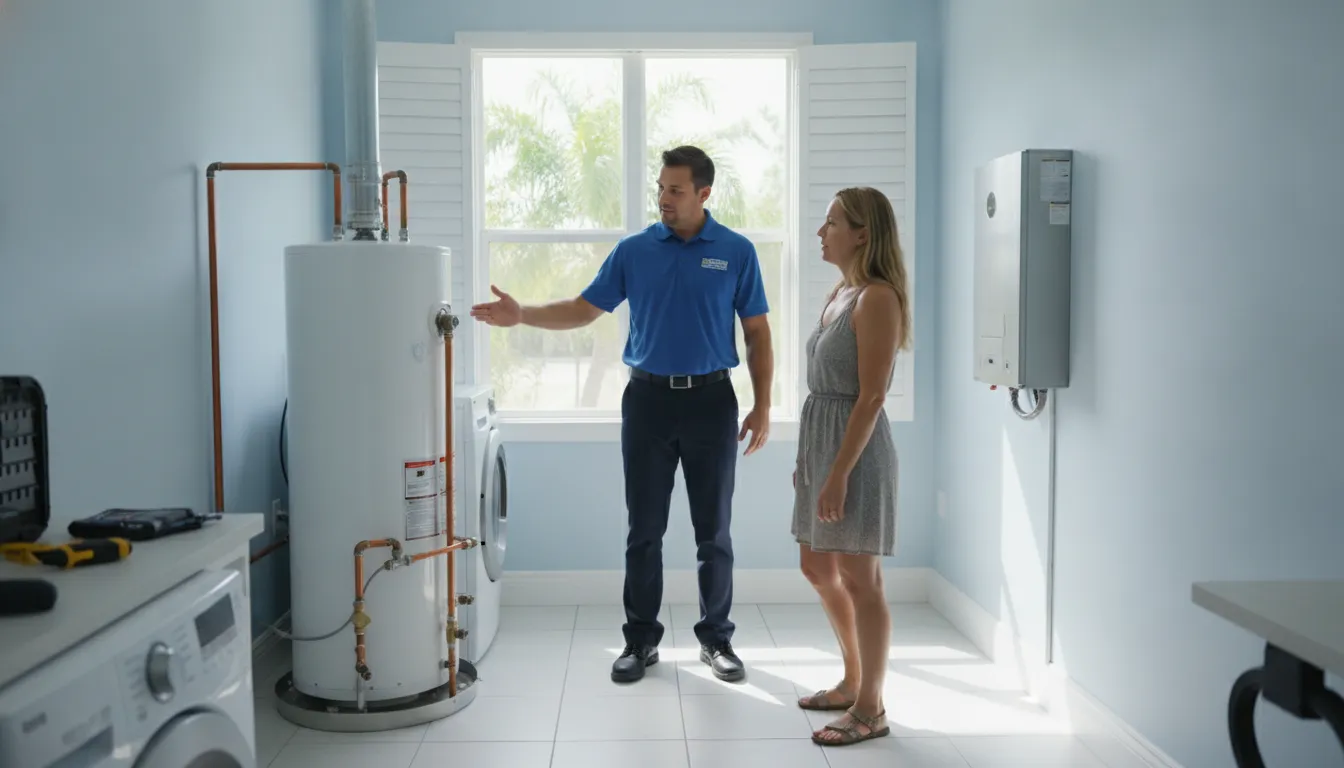
The central difference is simple: a traditional tank water heater stores and continuously reheats a supply of hot water, while a tankless unit heats water as your household calls for it. That choice affects how hot water is delivered, how much space the equipment uses, and how the system fits your daily routine in Florida.
A storage tank keeps a reserve ready for showers, laundry, dishwashing, and other household needs, and because it keeps that reserve between uses, it can experience standby energy losses. The U.S. Department of Energy explains that tankless, or demand-type, water heaters produce hot water only when it is needed and avoid those standby losses. Read the Department of Energy's explanation of tankless water heaters for the underlying efficiency principles.
How hot water availability changes
With a properly sized tankless system, hot water can continue as long as the unit can meet the household's demand. Consumer Reports describes tankless systems as providing an endless supply of hot water on demand, while storage tanks can run out during periods of heavy use. That difference can matter when guests are visiting, several family members are showering, or laundry and dishwashing overlap.
A tank, however, offers a familiar buffer. The stored water is already heated, so the system can serve several uses from its reserve until that supply is depleted. Once the tank runs low, the household may need to wait for the water to reheat. For some Treasure Coast homes, that predictable reserve is more valuable than continuous on-demand delivery.
Why Florida conditions belong in the decision
Hot, humid weather encourages year-round home comfort routines, and hard water across parts of the Treasure Coast can contribute to mineral scaling. A tankless heater can be an excellent fit, but it should be sized for the home's actual flow demands and evaluated alongside the water quality. In harder-water areas, planned maintenance and water treatment may help protect efficiency and performance.
Neither option is automatically best for every Port St. Lucie, Stuart, Vero Beach, or Fort Pierce home. Household size, simultaneous hot-water use, available installation space, fuel source, and maintenance expectations all matter. A local professional can compare those factors and provide a written recommendation. You can then choose a system based on how your home operates, not on a one-size-fits-all claim.
Want a side-by-side review for your home? Contact Miranda Plumbing & Air and we will size a system around your actual hot-water use.
How Do Tankless and Tank Water Heaters Compare on Energy Costs?
The water heater can have a meaningful effect on a Florida household's utility budget. In fact, heating water is the average home's second-highest utility cost after heating and cooling, according to Consumer Reports. That makes efficiency worth considering, but the best choice depends on how much hot water your household uses and how well the system is maintained.
A tankless heater heats water only when a fixture calls for it, so it does not keep a stored supply hot and avoids the standby energy losses associated with conventional storage tanks, according to the U.S. Department of Energy. For homes using 41 gallons or less of hot water per day, demand water heaters can be 24% to 34% more energy-efficient than storage models. This can make a tankless system appealing for a smaller household, a seasonal residence, or homeowners who want to reduce ongoing energy use.
The advantage can be smaller in a high-use home, but it does not disappear. At roughly 86 gallons of hot water per day, demand heaters can be 8% to 14% more energy-efficient than conventional tanks, according to the Department of Energy. A larger family may use more hot water overall, so even a smaller percentage improvement can still matter over time. However, savings on the utility bill should be weighed against the higher purchase and installation cost of many tankless systems.
Treasure Coast conditions also deserve attention. Hard water can leave mineral scale inside water-heating equipment, restricting performance and reducing real-world efficiency if maintenance is overlooked. A tankless unit may need regular flushing or descaling, and a water-softening or treatment strategy may be appropriate for some homes. These local factors can affect whether the expected energy savings show up consistently on your monthly bill.
For a fair comparison, review your household's hot-water habits, current utility use, available fuel source, and maintenance needs. A tank may still be practical for predictable demand and a lower initial budget. Tankless may offer better long-term efficiency when properly sized and maintained. A local evaluation can turn those general estimates into a recommendation based on your home's actual usage. Our Tankless Water Heater Treasure Coast guide covers sizing and ownership in more detail.
Upfront Installation Costs: What Treasure Coast Homeowners Expect to Pay
Purchase price is often the first difference homeowners notice when comparing a storage tank with a tankless system. Traditional tanks generally cost less to buy, while tankless equipment carries a higher price and may require more involved installation. The right comparison is the complete project cost, the home's hot-water demands, and how long you expect the system to serve your household, rather than just the unit price.
| Consideration | Storage tank | Tankless |
|---|---|---|
| Upfront unit cost | About $500-$1,200 | About $1,000-$4,250 before significant installation expenses |
| Installation complexity | Usually a more familiar replacement when the existing setup is suitable | May require significant installation work, correct sizing, and changes to utilities or venting |
| Typical total | Lower initial project cost in many homes | Higher initial project cost, varying with the home's layout and requirements |
| Payback horizon | Lower entry cost, with savings evaluated against expected service life and operating costs | Longer horizon, with potential operating and longevity benefits considered over time |
Consumer Reports lists traditional tank units at roughly $500-$1,200, while tankless units range from about $1,000-$4,250, plus significant installation expenses. Those figures are useful planning ranges, not a substitute for a home-specific quote. A Treasure Coast installation may also need to account for hard-water scaling, available space, fuel type, household demand, and the condition of existing connections.
Planning matters because the American Council for an Energy-Efficient Economy reports that 90% of water heater installations happen during an emergency. When a tank is leaking or the household has no hot water, it is harder to compare options calmly. If your current heater is aging, request a written estimate before it fails. Ask the contractor to separate equipment, installation, required upgrades, permits, maintenance recommendations, and warranty coverage. That makes the tankless heater vs tank decision easier to evaluate without relying on a rushed verbal price.
Miranda provides water heater replacement services with straightforward, written pricing. A clear quote can show whether the lower initial cost of a tank better fits your plans or whether a tankless system's higher investment makes sense for your home's long-term needs.
How Long Do Tankless and Tank Heaters Last in Florida?
Service life is an important part of comparing water heaters, but the number on the warranty label is only one part of the decision. In Treasure Coast homes, mineral-heavy water can influence how well either system performs over time. Planning for maintenance alongside purchase cost helps you choose equipment that fits your household and remains efficient through Florida's long, demanding cooling and plumbing seasons.
Expected Lifespan
Tankless water heaters generally have the longer service life when they are correctly sized, installed, and maintained. The U.S. Department of Energy says most tankless models last more than 20 years, compared with roughly 10 to 15 years for conventional storage heaters. Energy.gov's guidance also notes that tankless units have replaceable parts that may extend their useful life.
Consumer Reports gives a similar comparison, estimating 15 to 20 or more years for tankless systems and about 8 to 12 years for traditional tank models. These are useful planning ranges, not guarantees. Water quality, household demand, installation quality, and regular service all affect the result. A tank system may still be the practical choice when a lower initial investment or simpler replacement is the priority. A tankless system may make more sense when conserving floor space and planning for longer-term ownership matter more.
Hard Water and Descaling
Hard water is a routine consideration across parts of the Treasure Coast, including communities around Port St. Lucie, Stuart, and Vero Beach. Dissolved minerals can form scale inside water-heating equipment. Over time, that buildup can reduce heat transfer, affect efficiency, and make hot-water performance less consistent. It is a manageable maintenance issue, but it should be included in the ownership plan from the beginning.

Consumer Reports recommends annual descaling and flushing for tankless systems, with this service especially important in hard-water areas. A professional can assess the water conditions, confirm the equipment is sized correctly, and recommend a maintenance schedule suited to your home. Depending on the water quality, treatment such as softening may also help reduce mineral buildup. Storage tanks benefit from maintenance as well, including inspection and flushing when appropriate, although the specific service schedule depends on the model and installation.
If you notice fluctuating water temperature, reduced hot-water flow, or unusual noises, Miranda can evaluate the cause. We will explain your options before any work begins. Our licensed team provides straightforward recommendations and written pricing before work begins. Learn more about water heater repair for Treasure Coast homes, and review our water heater maintenance guide for a service schedule.
Space, Flow Rate, and Endless Hot Water: Daily Realities
One of the most noticeable differences in daily life is the amount of room a water heater occupies. A conventional storage tank can take up a substantial part of a garage, utility closet, or laundry area. Consumer Reports notes that common storage models hold 40 to 80 gallons, while tankless units are compact and wall-mounted. That frees floor space for storage, bicycles, tools, or easier access to other equipment. In a Treasure Coast home where garages and utility areas already work hard, that change can be practical rather than merely cosmetic.
What "endless" hot water feels like
A tank water heater stores a set volume of heated water. During a busy morning, several showers, a load of laundry, and dishwashing can use that supply faster than the system can recover. The familiar result is a shower that starts comfortably hot and ends with a cold interruption. Consumer Reports describes tankless systems differently: they heat water on demand and can provide a continuous supply, so the household is less likely to run out during ordinary periods of use. Consumer Reports explains the daily-use difference between tankless and storage water heaters.
That benefit is especially useful for larger families, multigenerational households, or homes that regularly host guests. It does not mean every fixture can draw unlimited hot water at once. The U.S. Department of Energy reports that tankless systems typically deliver about 2 to 5 gallons per minute. If multiple showers, appliances, or fixtures operate simultaneously, the available flow can become the limiting factor, even with a large gas-fired model.
Why sizing matters in a Florida home
Proper sizing starts with the household's busiest likely hour, not just the number of people in the home. A smaller household with staggered usage may be comfortable with one properly selected unit. A larger household may need a higher-capacity model, a different fuel configuration, or a system designed to support overlapping demands. In Florida, local water conditions matter too. Hard water can contribute to mineral buildup, so the installation plan should account for maintenance and, where appropriate, water treatment. For more on the broader comparison, see our Tankless vs Traditional Water Heater guide.
The right choice should make the home easier to use, not create a new limitation. A licensed local plumber can measure peak demand, review available space, and explain how the proposed system will perform before work begins.
Ready to plan before your current unit fails? Book a water heater consultation and compare written tankless vs tank options with a licensed expert.
How to Choose the Right Water Heater for Your Florida Home
The best choice depends on how your household uses hot water, how your home is arranged, and how much maintenance fits your routine. A tankless model may reduce standby energy loss and provide strong long-term value, while a conventional tank can offer a simpler installation and lower initial cost. Use these steps to compare the options with a licensed local professional.
Assess your household's hot water demand
List when your household uses hot water and whether showers, laundry, dishwashing, or other fixtures overlap. Tankless units heat water as needed, but their flow is limited when several hot water appliances run at once. A properly sized system should match your peak demand, not just the number of people in the home. If your usage is modest, demand heaters can be 24% to 34% more energy-efficient than storage tanks in homes using 41 gallons or less per day, according to the U.S. Department of Energy.
Check the available space and utility layout
Measure the existing installation area and note the location of gas, electrical, water, and venting connections. Tankless heaters are compact, wall-mounted systems, while storage heaters commonly occupy floor space with a 40- to 80-gallon tank. A tankless conversion may require changes to gas capacity, electrical service, or venting, so the physical fit is only one part of the installation decision.
Weigh efficiency against upfront cost
Compare the complete project cost rather than the equipment price alone. Traditional tank units generally cost less to purchase, with reported unit prices of about $500 to $1,200. Tankless units may cost $1,000 to $4,250 before significant installation expenses. Energy savings, available space, expected service life, and your planned time in the home can help determine whether the higher initial investment makes sense.
Plan for Treasure Coast hard water
Hard water can leave mineral scale inside water-heating equipment, reducing efficiency and shortening service life. Tankless systems especially need annual descaling and flushing in hard-water areas. Ask whether filtration or water softening should be part of the plan, and include the ongoing maintenance cost in your comparison. This local detail matters in communities across the Treasure Coast, including Port St. Lucie, Stuart, and Vero Beach. Where mineral buildup is a concern, water softening in Port St. Lucie can help protect your equipment.
Allow time for a planned replacement
Do not wait until a failed unit forces a rushed decision if you can plan ahead. The American Council for an Energy-Efficient Economy reports that 90% of water-heater installations occur during an emergency. Scheduling an evaluation early gives you time to compare tank and tankless options, confirm sizing, and choose an installation date that fits your household.
Get a written quote from a licensed local expert
Ask for equipment, installation changes, permits, maintenance recommendations, warranty coverage, and total pricing in writing. Miranda's licensed plumbing team, credential CFC1427227, can review your home's layout and usage before recommending a solution. See the available water heater replacement services and request a clear quote with no hidden fees.
Frequently Asked Questions
Which water heater is more energy-efficient?
Tankless models generally use less energy because they heat water only when you need it, rather than maintaining a stored supply. The U.S. Department of Energy reports that demand heaters can be 24% to 34% more efficient for homes using 41 gallons or less of hot water per day, while the advantage is typically 8% to 14% for homes using about 86 gallons daily (U.S. Department of Energy).
How long does each type of water heater last?
With appropriate installation and maintenance, a tankless unit typically lasts more than 20 years, compared with about 10 to 15 years for a conventional storage tank, according to the U.S. Department of Energy (U.S. Department of Energy). Local water quality, usage, and maintenance still affect the service life of either system.
Can a tankless water heater run out of hot water?
A properly sized tankless heater continuously heats incoming water, so it does not run out because a storage reservoir is empty. However, its flow capacity can be limited when several showers or hot-water appliances operate at once. A tank model can run out temporarily during periods of heavy use while it reheats.
What maintenance does a tankless water heater need in Treasure Coast homes?
Plan on annual descaling and flushing to remove mineral buildup, especially in hard-water areas such as the Treasure Coast. Consumer Reports identifies this maintenance as particularly important for tankless systems (Consumer Reports). A professional can also assess whether water treatment would help protect the system.
Which option costs less to install?
A conventional tank usually has the lower upfront cost. Consumer Reports lists typical tank unit prices of $500 to $1,200, while tankless units commonly cost $1,000 to $4,250 before installation differences are considered (Consumer Reports). A written quote can account for your home's fuel, electrical, venting, water-quality, and hot-water demands.
Book an Appointment for the Right Water Heater
Choosing between a tankless and tank water heater depends on your household's hot-water needs, available space, and the hard-water conditions common across the Treasure Coast. A consultation can help you compare practical installation options and plan with confidence. Book an appointment for a water heater consultation or installation estimate with Miranda Plumbing & Air today.
Need plumbing or HVAC service on the Treasure Coast?
Contact Miranda Plumbing & Air