
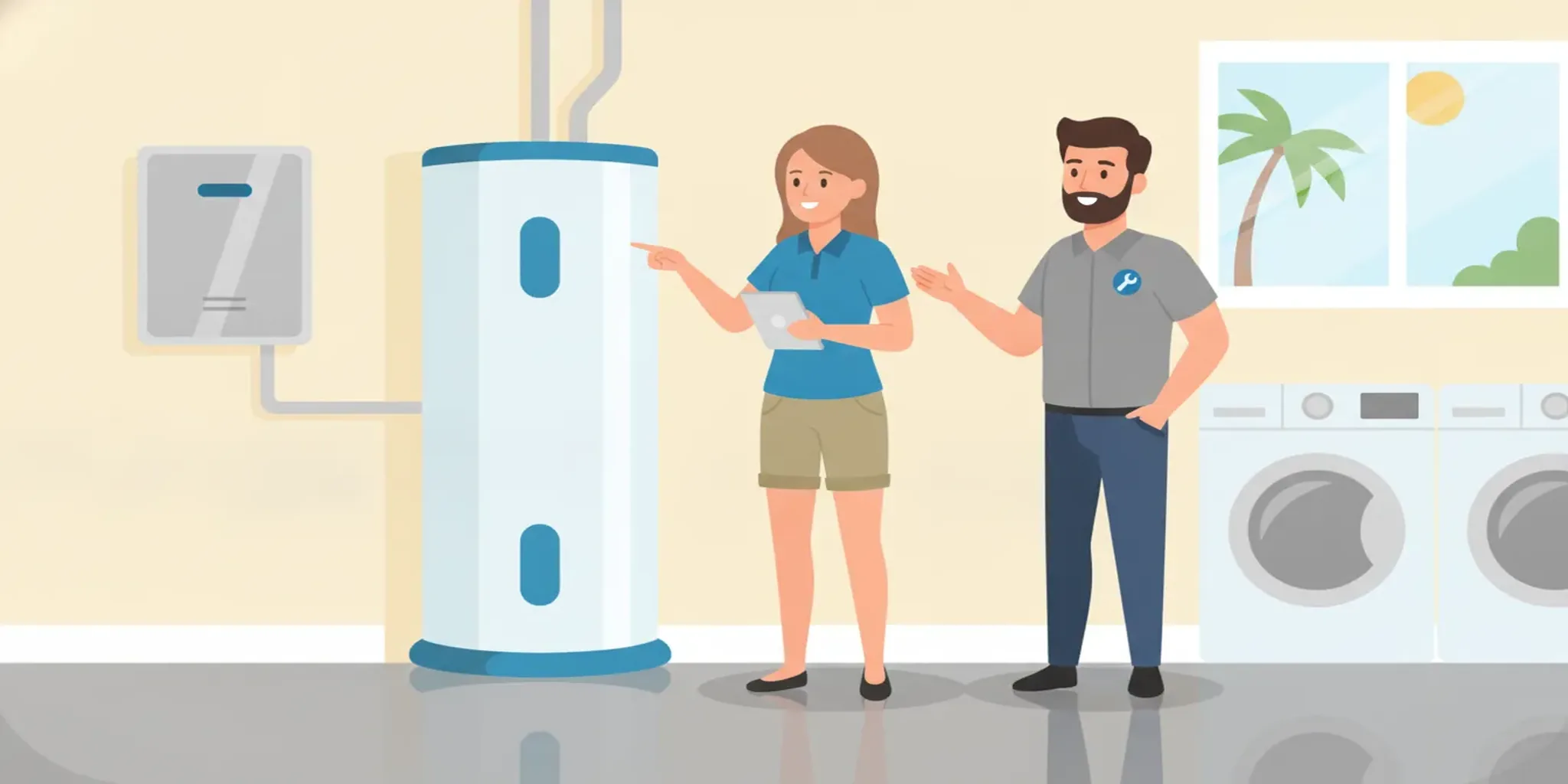
Tankless Water Heater vs Tank Stuart FL Guide
Choosing a water heater in Stuart is not simply a choice between newer and older technology. Your household size, hot-water habits, available fuel, electrical service, and installation space all affect the better fit.
Contact Miranda for a practical water heater recommendation in Stuart.
When comparing a tankless water heater with a tank in Stuart. Tankless systems can reduce standby heat loss and may last longer, while storage tanks offer a ready reserve for simultaneous use. The right choice depends on capacity, installation requirements, maintenance, and how your home uses hot water.
Tankless units generally cost more initially, but they heat water as it flows and avoid keeping a full tank hot. Storage heaters can simplify replacement and support several hot-water demands at once. Understanding how each system works makes the tradeoffs easier to evaluate.
How Do Tank and Tankless Water Heaters Work?
A storage-tank heater warms water and keeps it ready in an insulated reservoir. A tankless heater waits for demand, then heats water as it passes through the unit. Miranda can compare both designs based on your household size, fuel source, available space, and hot-water habits in Stuart.
With a traditional storage system, cold water enters the tank as hot water leaves it. A burner or electric heating element warms the stored supply. The system cycles periodically to maintain the set temperature, even when nobody is using hot water. That reserve can support several fixtures during the same period, although the available supply depends on tank capacity and household demand.
A tankless system has no large reservoir. When you open a hot-water faucet, a flow sensor activates the unit. Cold water travels through a heat exchanger, where a gas burner or electric element heats it before it reaches the fixture. This design avoids the standby heat loss associated with keeping a tank hot. The ENERGY STAR water-heater guidance provides additional information about efficient equipment choices.
What does on-demand hot water actually mean?
On-demand does not mean unlimited hot water at every fixture. It means the heater produces hot water while water flows through it, instead of drawing from a stored reserve. The unit still has an output limit. If multiple showers, washing machines, or faucets run together, demand may exceed its capacity. Correct sizing matters more than the label alone.
Storage and tankless systems also respond differently to interruptions. A tank provides a reservoir that can be used until its hot supply is depleted. A tankless unit depends on water flow, fuel, electrical controls, and the heat exchanger working together. In either case, installation should account for venting, plumbing connections, electrical service, and the home's peak demand. Miranda can evaluate those details before recommending a replacement or new installation.
What Does a Tankless Water Heater vs Tank Stuart FL Comparison Reveal About Cost and Efficiency?
For a tankless water heater vs tank Stuart FL decision, Miranda helps homeowners compare the full ownership picture, not just the equipment. Tankless systems may reduce standby energy loss, while storage tanks often offer a simpler replacement path. The better value depends on installation requirements, household demand, fuel, and expected time in the home.
What affects the upfront installation decision?
A storage tank replacement may fit existing water, fuel, venting, and electrical connections with fewer changes. A tankless installation requires careful review of the unit's fuel source, gas line capacity or electrical service, venting, condensate drainage, and mounting location. Those requirements can increase project complexity even when the wall-mounted unit uses less floor space.
Sizing also affects value. A unit that cannot meet peak demand may need supplemental equipment or a different configuration. A professional assessment should account for showers, laundry, dishwashing, and other fixtures that may operate together. That step protects efficiency and comfort better than choosing a model by nameplate capacity alone.
| Factor | Tankless system | Storage tank |
|---|---|---|
| Upfront project | May require fuel, electrical, venting, or plumbing updates. | Often follows the existing installation more closely. |
| Energy use | Heats water as needed and avoids storage standby loss. | Maintains a hot reservoir, so some heat loss occurs between uses. |
| Peak demand | Output depends on flow rate and incoming-water temperature. | Draws from stored capacity, supporting multiple uses until the reserve is depleted. |
| Long-term value | May favor homes with intermittent use and a suitable installation. | May favor homeowners prioritizing familiar equipment and a lower-complexity replacement. |
How does efficiency change the long-term comparison?
Tankless equipment does not keep a large volume of water hot between uses. That design can reduce standby loss, especially in homes with periods of low or intermittent demand. Actual utility results still depend on water use, fuel rates, incoming-water temperature, unit efficiency, and maintenance.
Storage tanks can remain financially practical when installation changes would be extensive or when the household needs a strong reserve for overlapping fixtures. Compare the installation scope and expected usage with Miranda before choosing. A clear evaluation of both options is more useful than assuming the higher-efficiency design always costs less overall.
Which System Handles a Stuart Household's Hot Water Demand?
For a Stuart household, the better choice depends on peak demand, fuel type, and daily routines. A storage tank offers a ready reservoir, while a tankless unit heats water as it flows. Miranda can size either system around your fixtures, household habits, and likely periods of simultaneous use. ENERGY STAR notes that even a large gas-fired tankless model may not supply enough hot water for multiple uses at once.
Think about the busiest 30 minutes in your home, not an average day. One person showering while a dishwasher runs may fit within a properly sized tankless system. Two showers, a washing machine, and a kitchen faucet running together create a much higher flow requirement. A storage heater draws from its stored reserve, so it can support several fixtures at the same time until that reserve is depleted.
How do flow limits affect tankless performance?
Tankless units are commonly rated by gallons per minute. The unit must heat incoming water quickly enough to maintain the selected temperature. Gas-fired models generally provide higher flow rates than electric tankless models, but the right choice still depends on the home's fuel supply and electrical service.
Florida's warm incoming water can affect the amount of heating required, but it does not make output unlimited. A professional sizing review should account for each showerhead, faucet, appliance, and fixture that may operate together. It should also consider whether household routines overlap in the morning or evening.
Installation conditions matter, too. A replacement may require changes to gas piping, venting, electrical capacity, plumbing connections, or equipment placement. Review your options through Miranda's water heater installation and replacement service before choosing based on capacity alone.
Which household routines favor each system?
- A tank may fit better: several people need hot water at overlapping times, and the home already has suitable tank infrastructure.
- Tankless may fit better: usage is spread throughout the day, floor space is limited, and the unit can meet the home's peak flow demand.
- Either system may work: routines are moderate, but correct sizing and fuel compatibility remain essential.
The practical comparison is not simply tankless versus tank. It is whether the system can meet your home's highest combined demand without exceeding its flow, recovery, or stored-capacity limits.
How Do Space, Lifespan, and Maintenance Compare?
For Stuart homeowners, tankless systems usually save floor space and may last longer, while storage tanks offer familiar maintenance and a built-in reserve. Miranda can compare your layout, water use, and equipment before you choose. ENERGY STAR information places tankless service life at approximately 20 years, but that figure is not a guarantee.
A storage water heater needs room for a tall cylindrical tank, along with clearance for connections and future service. That footprint can matter in a utility closet, garage, or compact mechanical area. A tankless unit mounts on the wall and removes the floor space used by the reservoir. The installation still needs suitable access, venting, fuel, electrical capacity, and plumbing connections.
That difference can make tankless attractive when you are reclaiming storage space or planning a remodel. However, the unit cannot simply move to any convenient wall. An installer should confirm clearances, vent routing, gas or electrical requirements, and the distance to fixtures. Review your water heater installation options before assuming a compact unit will fit.
What does service life mean in practice?
ENERGY STAR lists an approximate 20-year life expectancy for tankless water heaters. That is general guidance, not a promise for every home or a direct lifespan claim about every storage tank. Water quality, usage, installation quality, maintenance, and the specific equipment can change the outcome.
A tankless heater has no large reservoir that can corrode and eventually leak as the tank ages. A storage heater, by contrast, holds water continuously. Corrosion and sediment can increase the risk of leaks over time, so homeowners should watch for dampness, rust, unusual sounds, or inconsistent heating.
How does maintenance differ in Florida?
Tankless equipment commonly benefits from periodic inspection and descaling, especially where mineral buildup affects the heat exchanger. A filtration system may support broader water-quality goals, but it does not replace heater maintenance. Explore Miranda's water filtration installation services if local water conditions are part of your planning.
Storage heaters also need attention. Checking the tank, connections, temperature, and pressure-relief components can help identify trouble earlier. Neither design is maintenance-free. The better fit depends on how much space you have, how long you expect to stay. And whether you prefer a compact system with ongoing service needs or a familiar tank that may require earlier replacement.
What Should Stuart, FL Homeowners Know About a Tankless Water Heater vs Tank?
For most Stuart homeowners, the better choice depends on peak demand, available utilities, installation conditions, and long-term priorities. Miranda can help compare those factors without assuming one system fits every home. A tankless water heater may suit limited space and intermittent use, while a storage tank may suit predictable, simultaneous demand.
- List your busiest hot-water moments. Note whether showers, laundry, dishwashing, or other fixtures run together. Tankless output is limited by flow rate, and even large gas-fired models may not support multiple high-demand uses at once. A storage tank keeps a reserve that can support simultaneous use.
- Check the home's installation requirements. Fuel type, electrical capacity, venting, plumbing connections, and available space all affect feasibility. Tankless models are often wall-mounted and compact, but a conversion may require more planning than a standard tank replacement. Ask about water-heater installation and sizing before choosing equipment.
- Decide how you value efficiency and service life. Tankless systems heat water as needed and avoid standby heat loss. ENERGY STAR lists an approximate 20-year life expectancy for tankless water heaters. Actual results depend on equipment, water conditions, maintenance, and use, so treat that figure as general guidance.
- Consider maintenance and household habits. A tankless system may require heat-exchanger descaling, especially where mineral buildup is a concern. A storage tank may be simpler to replace, but it occupies more floor space and can eventually develop corrosion or sediment problems. Choose the system your household can maintain consistently.
There is no universal winner when Stuart homeowners compare a tankless water heater with a storage tank. A properly sized tankless unit may work well for a smaller household with space constraints. A storage tank may remain practical for larger households that regularly use several fixtures together. A professional evaluation can identify the safer fit.
When Should You Repair or Replace a Water Heater?
Repair is often reasonable when a water heater has one isolated, diagnosable problem and the tank or heat exchanger remains sound. Replacement deserves attention when leaks, repeated failures, corrosion, or unreliable hot water point to broader wear. Miranda can inspect the system and explain the safest next step for your Stuart home.
Turn off the water heater and arrange prompt service if you notice water pooling, a strong gas odor, smoke, scorching, or unusual electrical sounds. Do not open sealed gas controls, bypass safety devices, or attempt electrical repairs without the right training. A visible leak from the tank itself generally signals a replacement issue, not a simple repair.
Repair may make sense when the problem is limited to a replaceable component, such as a thermostat, heating element, valve, connection, or ignition part. The correct answer depends on the equipment type, age, condition, maintenance history, and availability of compatible parts. A technician should also check whether the unit is correctly sized for the household's demand.
Replacement becomes more practical when service calls keep recurring, hot water output has declined, or the existing system no longer fits the home's needs. Switching from a tank to tankless can involve changes to fuel supply, electrical capacity, venting, plumbing, and mounting. Review water heater installation and replacement options before choosing equipment.
For tankless systems, mineral buildup can affect performance, especially in hard-water conditions. Ask about maintenance and filtration rather than assuming a new unit will operate without service. Miranda's water heater repair and diagnosis service can help identify whether a repair is appropriate or whether replacement planning is wiser. A professional evaluation protects against replacing a fixable part or postponing a failure that could damage your home.
Contact Miranda to schedule a water heater diagnosis in Stuart.
Frequently Asked Questions
Is a tankless water heater better than a storage tank in Stuart?
Neither system is best for every home. Tankless may suit homeowners who value floor space and on-demand heating. A storage tank may fit households that prefer a simpler replacement and a ready reservoir. Miranda can compare your usage, fuel, electrical service, and installation space before recommending an option.
Can a tankless water heater handle several fixtures at once?
It can, if the unit is sized for the home's peak demand. However, output is limited, and simultaneous showers, laundry, and dishwashing may exceed one unit's capacity. A storage tank can support multiple uses by drawing from its stored hot-water reserve. ENERGY STAR explains tankless capacity and continuous-flow considerations.
Is replacing a tank with a tankless water heater a simple swap?
Usually, it requires more than disconnecting one heater and connecting another. The installer may need to evaluate gas supply, electrical capacity, venting, plumbing, drainage, and mounting access. Miranda should size the replacement around your fixtures and household routines, not the old tank's label alone.
Do tankless water heaters need special maintenance in Florida?
They can need periodic heat-exchanger cleaning when mineral buildup affects performance. Local water conditions, usage, and the equipment design influence the maintenance plan. Ask Miranda about filtration, flushing, and other service needs before choosing a tankless system for your Stuart home.
How long can a tankless water heater last?
Service life depends on installation quality, water conditions, maintenance, and usage. ENERGY STAR lists an approximate 20-year life expectancy for tankless water heaters. Treat that figure as general guidance, not a guarantee, because equipment, water conditions, maintenance, and use affect service life.
Ready to Choose the Right Water Heater?
The best fit depends on your household's hot water demand, available space, installation conditions, and future plans. Miranda Plumbing & Air can help you compare those factors for your Stuart home and identify a practical next step.
Contact Miranda Plumbing & Air to discuss your water heater options.
Need plumbing or HVAC service on the Treasure Coast?
Contact Miranda Plumbing & Air