
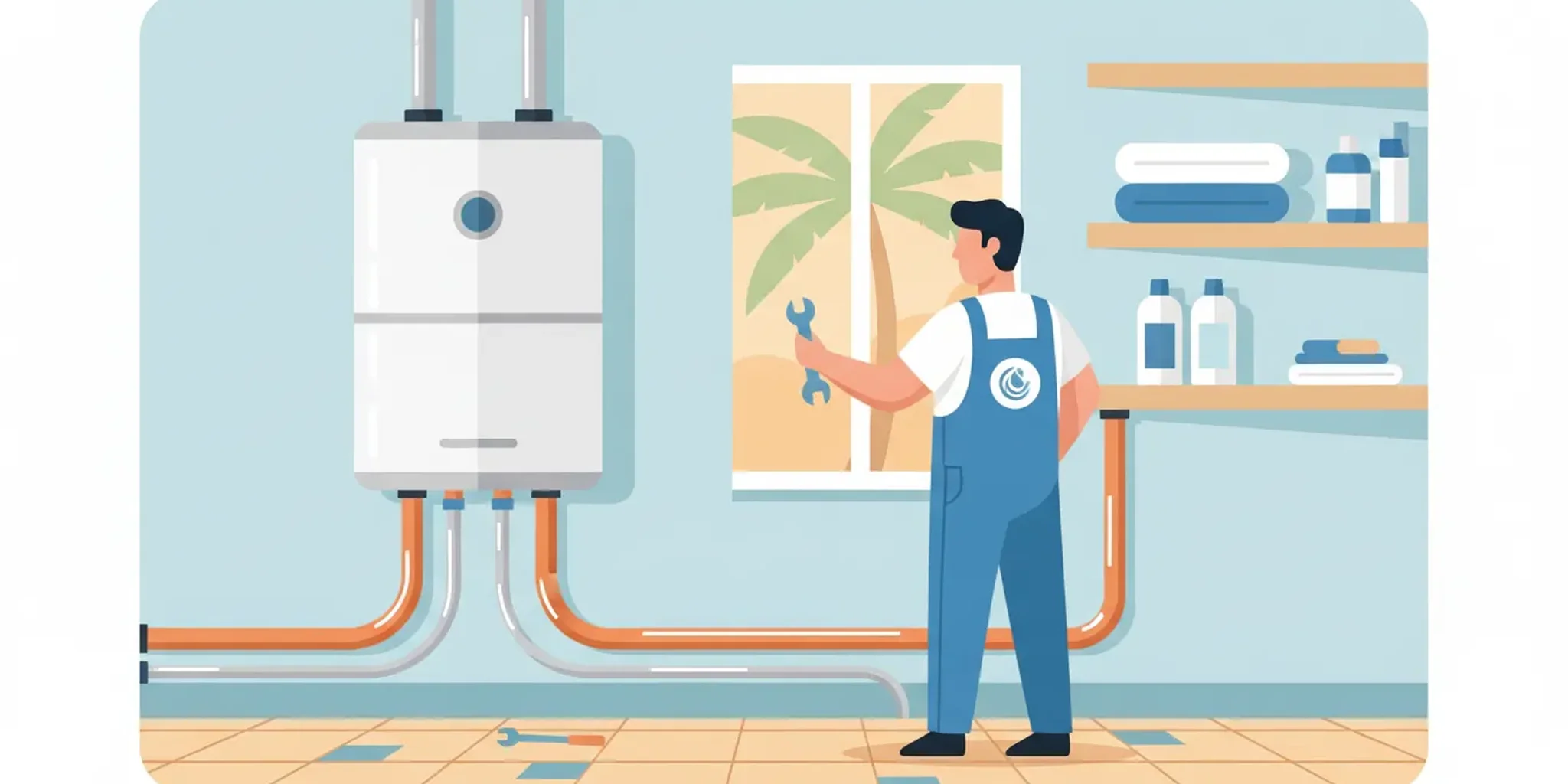
Tankless Water Heater Florida: The Complete Guide
Florida homeowners often think a larger water heater is the only way to keep up with back-to-back showers, laundry, and the demands of a busy household. In reality, the right system depends on your home's hot-water usage, available fuel, electrical service, and installation space.
A tankless water heater florida homeowners choose can deliver hot water on demand, take up less space, and avoid the standby losses of a storage tank. It may also last longer than a traditional tank system, but the higher installation cost. Water quality, maintenance needs, and gas or electrical requirements should be part of the decision.
For Treasure Coast homes, Florida's heat, hard water, humidity, and coastal air can all affect equipment selection and upkeep. Understanding how the system responds to a hot-water demand is the best place to start before comparing efficiency, cost, and long-term value.
Book an appointment with a licensed Florida water heater specialist today
How Does a Tankless Water Heater Work in a Florida Home?
A tankless water heater uses a demand-based process instead of keeping a large tank of water hot all day. When someone opens a hot-water faucet, a flow sensor detects the demand and activates the heating elements or gas burner. Water moves through a heat exchanger, warms as it passes through, and then travels to the fixture. When the faucet closes, the unit stops heating.
That differs from a traditional storage water heater, which repeatedly reheats water sitting in its tank, even when nobody is using it. Because tankless equipment heats water only as needed, it avoids the standby energy losses associated with storage models. ENERGY STAR describes tankless systems as a way to provide hot water on demand without the ongoing heat loss of a storage tank. Learn more about water-heater efficiency from ENERGY STAR.
Why does on-demand heating matter in Florida?
Florida homes can have a steady demand for hot water throughout the year. A morning may include several showers, followed by laundry, dishwashing, and cleaning. Seasonal visitors can add even more demand when everyone is using the home at the same time. With a properly sized unit. A tankless system can provide a constant supply of hot water rather than making the last person wait for a storage tank to refill and recover.
The system does not create unlimited flow at every possible fixture. Its output depends on the unit's capacity, the temperature of incoming water, and how many fixtures operate simultaneously. A professional installer can calculate the required flow rate and temperature rise for the home, then recommend whether one whole-home unit or multiple units are appropriate.
Tankless equipment is also compact and commonly wall-mounted, which can help Florida homeowners reclaim floor or closet space. Proper installation still matters. Gas units need appropriate venting and fuel capacity, while electric models may require sufficient electrical service. Water quality and mineral buildup should also be considered when planning maintenance.
Explore tankless water heater installation options
Is a Tankless Water Heater Worth It for Florida Homeowners?
For many Florida homeowners, a tankless water heater is worth considering when long-term efficiency, space, and a dependable hot-water supply matter more than the lowest upfront price. The best fit depends on your household's daily usage, fuel source, plumbing layout, and the condition of the water heater installation area.
Efficiency is one of the clearest advantages. Because a tankless unit heats water as you need it, it avoids the standby energy losses associated with keeping a storage tank hot. For homes using 41 gallons or less of hot water each day. Demand water heaters can be 24% to 34% more energy efficient than conventional storage models, according to ENERGY STAR water-heater guidance. An ENERGY STAR certified gas tankless model can save a family of four about $95 per year on gas bills compared with a standard gas storage model. Although actual savings vary by usage, rates, and equipment.
Florida's climate adds practical reasons to evaluate the upgrade. In a hot, humid home, eliminating a bulky tank can free valuable closet space and reduce the concern of a tank-related leak. A wall-mounted unit also supports a cleaner installation in homes where utility space is limited. Tankless systems can provide a continuous flow of hot water, which is useful when several people need showers or appliances are running close together.
What Florida conditions should you consider?
Hard water can contribute to mineral buildup inside tankless components, so maintenance and water-quality planning are important. Homes near the coast should also account for salt air when selecting the installation location and protecting equipment. A qualified professional can review filtration, flushing intervals, ventilation, electrical capacity, and gas-line requirements before recommending a model.
For dependable results, work with a licensed plumbing professional who understands local conditions. Miranda Plumbing & Air is a Ruud Pro Partner and operates under plumbing credential CFC1427227. Our team can help compare tankless water heater installation options with your current system. If your existing unit is already struggling, tankless water heater repair may be the more practical first step.
Tankless models also typically last more than 20 years, compared with about 10 to 15 years for many storage water heaters. That longer service life can improve the overall value, especially for homeowners planning to stay in the property. But only when the unit is properly sized, installed, and maintained.
How Much Does a Tankless Water Heater Cost to Install in Florida?
For many Florida homeowners, a tankless water heater installation costs about $1,800 to $4,500 in total. That range includes the equipment and typical installation work. But the right price for your home depends on the fuel type, demand, existing connections, and the condition of the installation area. A straightforward replacement is usually less involved than converting from a storage tank to a tankless system.
The following breakdown provides a practical starting point for budgeting. These are typical estimates, not a guaranteed quote. Cost ranges can overlap because the final project may require more than one upgrade.
| Cost category | Typical range | What it may include |
|---|---|---|
| Electric unit | $500-$1,200 | Unit only, before labor and required electrical work |
| Natural gas or propane unit | $700-$2,000 | Unit only, before labor, venting, or gas-line work |
| Standard retrofit labor | $400-$900 | Labor for a relatively straightforward replacement |
| Gas-line or electrical upgrade | Additional $300-$800 | New or upgraded connections needed for the selected system |
| Typical installed total | $1,800-$4,500 | Common Florida project range, including equipment and installation |
Electric models generally cost less for the equipment itself, while gas and propane models can have higher unit prices and may require venting or gas-line changes. An electric conversion may also need electrical capacity or wiring upgrades. The existing location, access, code requirements, water-line configuration, and whether the system serves one fixture or the whole home can all affect labor.
For a more accurate budget, have a licensed local professional inspect the current setup and confirm the home's hot-water demand. Miranda Plumbing & Air is licensed under CFC1427227, and an upfront evaluation can identify connection work before installation begins. For dependable planning, request a quote for tankless water heater installation rather than relying on a national average or equipment-only price.
What Size Tankless Water Heater Does a Florida Home Need?
Choosing the right tankless water heater for a Florida home is less about the number of bedrooms and more about how much hot water your household may need at the same time. A plumber typically sizes the unit using two measurements: flow rate, measured in gallons per minute (GPM). And temperature rise, or the difference between the incoming water temperature and the temperature you want at the tap.
How do flow rate and temperature rise affect sizing?
Start by listing the fixtures that might operate together. A shower, kitchen faucet, bathroom faucet, and washing machine each require a certain flow rate. Add the likely simultaneous demand to estimate the total GPM your system must deliver. If two people regularly shower while an appliance is running, the unit needs to support that combined demand rather than only the flow from one fixture.
Temperature rise matters just as much. Tankless systems heat water as it passes through the unit, so a larger temperature increase requires more heating capacity. Florida's relatively warm incoming groundwater generally means less temperature rise than colder northern climates. That can help a properly selected unit perform well without being oversized, although local conditions and the home's plumbing setup still need to be evaluated.
Should a Florida home use whole-home or point-of-use heating?
A whole-home model is designed to serve multiple fixtures from one centrally located unit. It may be the better fit for a larger household or a home where several hot-water demands overlap. A point-of-use model serves one fixture or a small area. It can make sense for a distant bathroom, an addition, or a location where extending hot-water lines would create unnecessary work.
Oversizing is not automatically better. A unit that is too large may cost more than necessary, while one that is too small can struggle when demand rises. Tankless water heaters are typically compact and wall-mounted, which can free up storage space compared with a conventional tank, according to ENERGY STAR guidance.
For an accurate recommendation, have a licensed professional calculate the home's peak GPM, incoming water temperature, fuel availability, electrical requirements, and installation location. Miranda can help plan tankless water heater installation around your household's actual usage.
Gas vs Electric Tankless Water Heaters in Florida
Florida homeowners usually choose between a gas-fired or electric tankless water heater based on household demand, available utilities, and the home's electrical capacity. Both systems heat water only when needed, but they do not place the same demands on your home. The right choice should account for showers, appliances, incoming water temperature, and the distance between the heater and fixtures.
| Consideration | Gas tankless | Electric tankless |
|---|---|---|
| Unit cost | Typically $700-$2,000 for the unit | Typically $500-$1,200 for the unit |
| Fuel source | Natural gas or propane | Electricity |
| Installation needs | Gas supply, venting, combustion clearances, and condensate management may be required | High-amperage circuits, appropriate breakers, and sufficient electrical service may be required |
| Whole-home demand | Often a practical fit for simultaneous showers and appliances | May require multiple units or significant electrical upgrades for high demand |
| Efficiency | Can provide strong output for larger households; ENERGY STAR certified gas models may reduce energy use compared with standard storage models | Avoids combustion and venting, but operating cost depends on local electric rates and demand |
Electric models can be a sensible choice for a smaller home, a point-of-use application, or a property without a gas line. However, whole-home demand often makes gas the simpler option because electric tankless units can draw substantial current while operating. Some homes can support the demand with multiple electric units, but that approach may require a service evaluation, new circuits, or a larger electrical upgrade. A lower purchase price does not necessarily mean a lower installed cost.
Gas installation can also involve additional work, including properly sized gas piping, venting, and combustion-air requirements. The unit itself commonly costs more, with documented ranges of $700-$2,000 for gas or propane compared with $500-$1,200 for electric units. These are unit-only ranges, so the home's existing infrastructure matters. A licensed professional should calculate the required flow rate and confirm that the equipment meets local code.
Miranda Plumbing & Air is a Ruud Pro Partner and holds Florida credentials CFC1427227 for plumbing and CAC1815486 for HVAC. Our team can evaluate gas availability, electrical capacity, fixture demand, and installation conditions before recommending a system. If an existing unit is already showing performance problems, schedule tankless water heater repair before replacing it.
How Long Do Tankless Water Heaters Last in Florida?
A properly installed tankless water heater can serve a Florida home for more than 20 years. By comparison, a conventional storage water heater typically lasts about 10 to 15 years, according to the U.S. Department of Energy. That longer expected service life is one reason homeowners consider tankless systems when replacing an aging water heater.
Florida conditions make maintenance especially important. Mineral-heavy water can leave scale inside the heat exchanger, reducing water flow and forcing the system to work harder. Over time, untreated scale can affect heating performance and shorten the useful life of the unit. A professional descaling service helps remove those deposits and gives a technician an opportunity to check valves, connections, temperature settings, and system operation.
What maintenance helps a tankless water heater last longer?
For many Florida homes, annual professional service is a sensible baseline. The right schedule depends on water quality, household usage, the manufacturer's instructions, and whether the home has water treatment. A technician may flush the heat exchanger, inspect the filter, test safety components, and look for early signs of corrosion or restricted flow. Homes with harder water or high hot-water demand may need descaling more often than homes with lighter usage.
Good installation matters just as much as routine service. Correct sizing, water-line configuration, venting for gas models, electrical capacity for electric models, and adequate combustion air all affect reliability. Keep the service records and follow the manufacturer's maintenance requirements, particularly if the unit is covered by a warranty. As a Ruud Pro Partner, Miranda can help Florida homeowners review equipment options, installation requirements, and warranty considerations before replacement.
Do not wait for a complete failure if the unit produces inconsistent temperatures, displays repeated error codes, makes unusual noises, or shows a noticeable drop in flow. Tankless water heater repair may resolve a developing problem before it leads to a larger interruption. Regular care cannot make every system last indefinitely, but it can help protect performance and make the most of the longer lifespan a tankless design offers.
Call or book an appointment with Miranda Plumbing & Air for expert tankless water heater advice
Frequently Asked Questions
Do you need a permit to install a tankless water heater in Florida?
Usually, a tankless installation must meet applicable local building and plumbing requirements, and the permit process can vary by municipality and project scope. Your licensed installer should confirm the Treasure Coast requirements, obtain any needed permit, and arrange inspections before work begins.
What is the downside of a tankless hot water heater?
The main tradeoffs are higher upfront cost, possible gas-line or electrical upgrades, and the need for proper sizing. A tankless unit also requires periodic maintenance, especially where mineral buildup can affect performance. A professional evaluation helps determine whether the available fuel supply and household demand are a good match.
Is a tankless water heater worth it in Florida?
It can be a strong fit for Florida homeowners who want continuous hot water, a smaller wall-mounted unit, and less risk of a storage-tank leak. Tankless models also avoid standby energy losses. ENERGY STAR reports that certified gas models can save a family of four about $95 per year compared with a standard gas storage model: ENERGY STAR.
How much does a tankless water heater cost to install in Florida?
A typical installed project may range from about $1,800 to $4,500, depending on the unit, fuel type, location, venting, and required upgrades. A new gas line or electrical upgrade can add roughly $300 to $800, so an on-site assessment is more reliable than a package price.
Are electric tankless water heaters efficient for Florida homes?
Electric tankless units can be efficient because they heat water on demand instead of maintaining a hot storage tank. They still need adequate electrical capacity, and the right choice depends on household demand, panel capacity, utility rates, and installation conditions. Have the electrical requirements checked before selecting a model.
Ready to Choose the Right Water Heater?
A professional evaluation can help you compare tankless and traditional systems based on your home's hot-water needs, available utilities, and installation requirements. Miranda Plumbing & Air can answer your questions and help you plan the next step.
Book an appointment with Miranda Plumbing & Air to discuss your options, or contact the team through the same page for 24/7 emergency service.
Need plumbing or HVAC service on the Treasure Coast?
Contact Miranda Plumbing & Air