
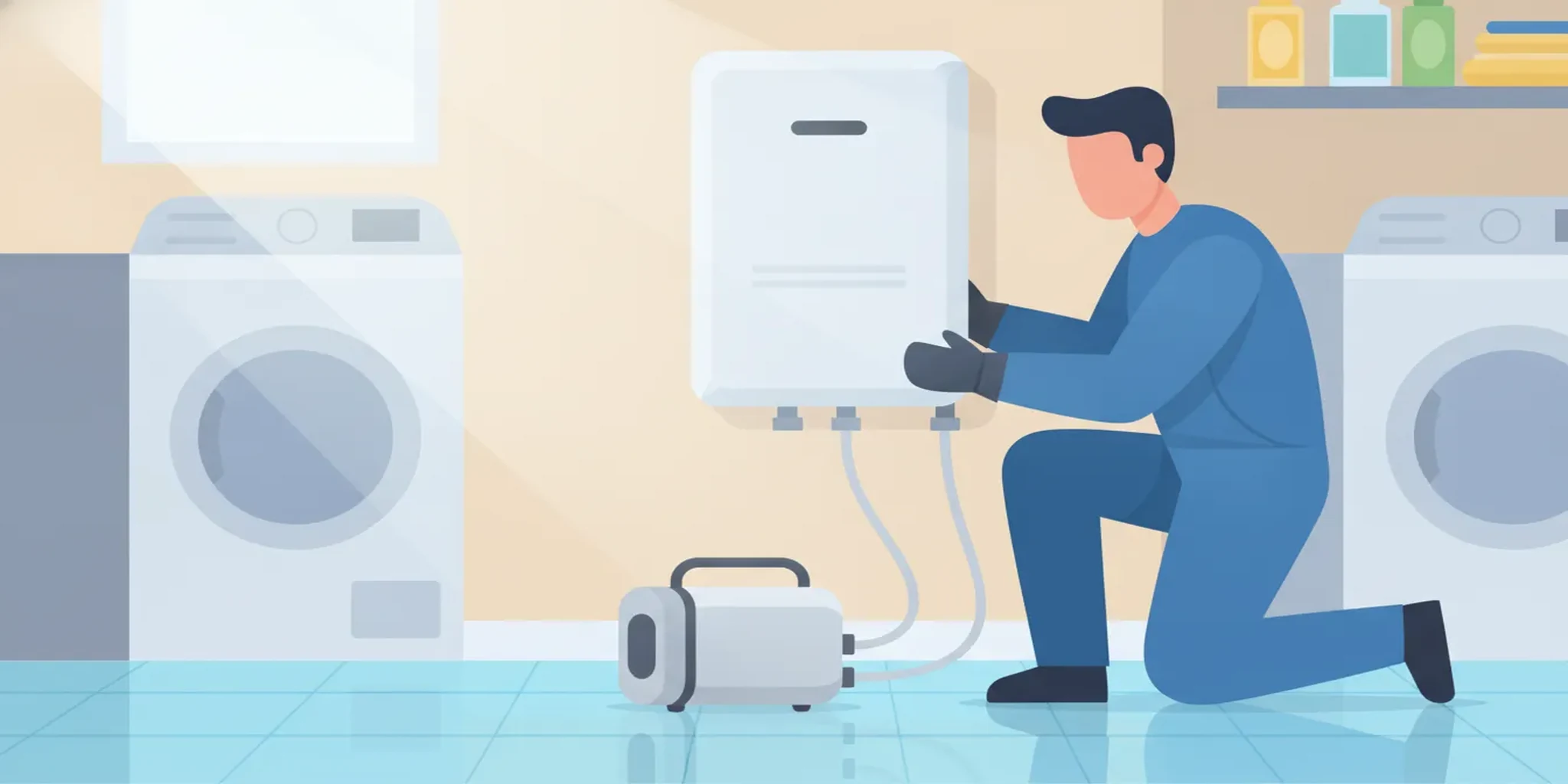
How to Descale a Tankless Water Heater: A Florida Guide
If your tankless water heater is taking longer to deliver hot water, producing uneven temperatures, or showing reduced flow, mineral scale may be building up inside the unit. In South Florida, hard water can speed that process and make routine maintenance especially important for homeowners in Stuart, Port St. Lucie, and nearby Treasure Coast communities.
Learning how to descale a tankless water heater can help you remove calcium buildup, protect heating performance, and extend the life of the system. Most homeowners use white vinegar, a submersible pump, two hoses. And a bucket to circulate the cleaning solution through the isolated heater, then flush the unit with clean water.
Before you begin, confirm the instructions in your owner's manual and make sure you can safely shut off the power or gas and water connections. It also helps to understand why scale accumulates so quickly in this region, because local water conditions determine how often your heater may need attention.
Why Does Scale Build Up So Fast in South Florida?
Treasure Coast homeowners deal with a water chemistry problem that can be hard on tankless water heaters. Much of the water in South Florida contains a significant mineral load, including calcium and magnesium. As water passes through the unit's compact heat exchanger, those minerals can collect on the internal surfaces and form scale.
Tankless systems are especially sensitive because the heat exchanger has narrow passages and must transfer heat quickly as water flows through it. A thin mineral layer can act like insulation around the exchanger. The unit then has to work harder to heat the same water, which can reduce efficiency and contribute to inconsistent temperature or lower flow. Over time, scale buildup is one of the leading causes of tankless water heater failure.
That is why knowing how to descale a tankless water heater matters more in Stuart, Port St. Lucie, and nearby Treasure Coast communities than it might in a softer-water area. Hard-water conditions generally call for more frequent descaling because deposits form faster. Waiting until the heater stops working can allow a maintenance issue to become a costly repair.
Regular care can make a major difference in service life. A properly maintained tankless water heater may last 20 years or more. But hard-water scale can contribute to premature failure in as little as three to five years when maintenance is neglected. Descaling helps protect the heat exchanger, preserve hot-water performance, and reduce the stress placed on the system. It is also a practical way to protect the investment you made in a tankless installation.
If scale has already caused poor performance, repeated error codes, or unusual temperature changes, maintenance may not be enough. A plumber can determine whether the unit needs cleaning, repair, or replacement. For homeowners comparing long-term options, professional water heater maintenance and installation guidance can help match the system to local water conditions.
How Often Should You Descale a Tankless Water Heater?
For most tankless water heaters, annual descaling is a sensible maintenance schedule. Removing mineral buildup once a year helps the heat exchanger transfer heat efficiently and supports the maintenance requirements that may apply to your unit's warranty. It also gives you a predictable opportunity to inspect the system before a small performance issue becomes an emergency.
Water quality can change that schedule. Homes on the Treasure Coast and elsewhere in South Florida often deal with hard water, which carries more dissolved minerals into plumbing equipment. If your water is especially hard, your unit may need descaling once or twice a year rather than only annually. A licensed plumber can help you determine the right interval based on the water conditions at your home and the amount of hot water your household uses.
Your manufacturer's manual should always be the final authority. Different brands and models can have specific instructions for the solution, isolation valves, circulation time, and maintenance frequency. Following those directions matters for safe operation and warranty compliance. If the manual calls for a shorter interval than once a year, follow the manufacturer's schedule.
What signs mean it is time to descale?
Don't wait for the calendar if your water heater is already showing symptoms of scale. A noticeable drop in hot-water flow, slower heating, or reduced heating capacity can indicate mineral buildup inside the heat exchanger. You may also notice that the unit struggles when more than one fixture is using hot water. These signs don't identify scale with certainty, but they are good reasons to review the maintenance history and arrange an inspection.
The circulation portion of a typical descaling service takes about 45 to 60 minutes. Additional time is needed to shut down the unit, connect the pump and hoses, flush the solution completely, and return the heater to service. Rushing the process or skipping the clean-water flush can leave residue in the system.
How to Descale a Tankless Water Heater Step by Step
Before you begin, confirm that your owner's manual allows white vinegar or specifies a different descaling solution. The method below uses a submersible pump to circulate the solution through the heater, then flushes the unit with fresh water. If you are not comfortable working near gas, electricity, or pressurized plumbing, arrange tankless water heater repair instead.
Wear chemical-resistant gloves and eye protection throughout the process. Keep children and pets away from the work area, and never open service valves while the heater is powered or the water supply is still pressurized.
- Turn off the energy supply. Switch off the electrical circuit serving the heater. If the unit uses gas, turn off the gas supply according to the manufacturer's instructions. Wait for the system to cool before opening any service connections.
- Isolate the water heater. Close the hot and cold water isolation valves so the descaling solution stays within the heater and connected service hoses. Open a nearby hot-water tap briefly to release residual pressure, then close it once the flow stops.
- Gather the equipment. You will need a submersible transfer pump, two short utility hoses, a 5-gallon bucket, and white distilled vinegar. Check that the hoses fit the heater's service ports securely. Keep towels nearby to catch small drips.
- Clean the inlet water filter. Follow the manual to remove the cold-water inlet filter. Rinse away trapped sediment and mineral debris, inspect the screen for damage, and reinstall it only after it is clean. A blocked filter can restrict flow and make the heater appear to have a larger problem.
- Connect the circulation loop. Attach one hose from the pump to the cold-water service port. Attach the second hose from the hot-water service port and place its open end into the bucket. Pour enough white vinegar into the bucket to cover the pump, then place the pump in the solution. Check every connection before starting it.
- Circulate the vinegar. Open the service valves as directed by the heater's manual and switch on the pump. Let the vinegar circulate through the heat exchanger for approximately 45 to 60 minutes. Stay nearby and watch for leaks, unusual noises, or a hose that shifts out of place. Turn off the pump immediately if a connection leaks.
- Drain the used solution. When circulation is complete, switch off and unplug the pump. Close the service valves, disconnect the loop carefully, and empty the used vinegar according to local disposal guidance. Do not restore the heater to service while solution remains in the system.
- Flush with fresh water. Reconnect the cold-water service hose to a clean water source or follow the manufacturer's flushing instructions. Open the cold-water service valve and allow fresh water to move through the heater and out through the discharge hose. Continue until the water runs clear and no vinegar odor remains, then close the service valves and remove the hoses.
- Restore operation. Reinstall service-port caps, confirm the inlet filter is secure, and reopen the hot and cold isolation valves slowly. Check for leaks. Restore the gas supply and electrical power in the order specified by the manual, then run a hot-water fixture and verify normal flow and temperature.
Do not force a stuck valve or continue if the heater displays an error code after flushing. Persistent low flow, leaking connections, or unusual temperature changes are signs that a professional should inspect the unit.
Can You Use Vinegar to Descale a Tankless Water Heater?
Yes. White distilled vinegar can dissolve the calcium and magnesium deposits that collect inside a tankless water heater. It is food-safe, widely available, and often the most economical option for routine maintenance. For a lightly scaled unit, vinegar can work well when it is circulated through the heat exchanger for the time recommended in the owner's manual.
Commercial descaling solutions are also a valid choice. Many are citric-acid based and formulated at a higher concentration than household vinegar. That can help them break down heavier buildup more quickly. The right choice depends on the amount of scale, the manufacturer's instructions, and how comfortable you are handling the flushing process.
| Consideration | White distilled vinegar | Commercial descaler |
|---|---|---|
| Cost | Usually the lower-cost option and easy to find locally. | Costs more, especially when purchased as part of a complete kit. |
| Strength | Household vinegar is commonly about 5% acidity. Higher-strength vinegar, such as 30%, is more concentrated and requires greater care. | Typically more concentrated and designed specifically to dissolve mineral scale. |
| Safety | Food-safe, but it is still acidic. Follow the heater and pump instructions, and never mix it with other cleaners. | Use the product label, gloves, eye protection, and the manufacturer's compatibility guidance. |
| Time | May need longer circulation when deposits are substantial. | Often works faster because the solution is formulated for descaling. |
Do not assume that stronger is always better. A 30% vinegar solution is substantially stronger than the 5% vinegar commonly used at home, and it may not be appropriate for every heater, seal, or component. Check the manual before choosing a solution, and do not exceed the recommended concentration or circulation time.
For routine maintenance, either option can be effective when the heater is isolated correctly, the solution is circulated through the unit, and the system is thoroughly flushed afterward. If you see persistent error codes, very low flow, or heavy deposits after years without maintenance, professional water heater repair services may be safer than repeated DIY attempts.
When Should You Call a Professional Plumber?
Descaling is a manageable maintenance task when the unit is accessible, the equipment is in good condition, and you feel comfortable following the manufacturer's instructions. It is not the right project for every homeowner, especially when scale has been allowed to build up for years.
Does the unit have severe buildup or ongoing warnings?
Heavy mineral buildup can restrict water flow and make a basic vinegar flush less effective. If the water heater has never been descaled, or if it has been neglected through several maintenance cycles, professional cleaning is the safer choice. A plumber can assess the unit before circulating a cleaning solution and determine whether the scale has affected valves, filters, connections, or the heat exchanger.
Persistent error codes, low-flow warnings, fluctuating water temperature, or repeated shutdowns also deserve professional attention. Descaling may resolve a restriction, but those symptoms can point to a sensor, control, gas, electrical, or plumbing problem that a cleaning cycle will not fix. Miranda can diagnose the cause and complete tankless water heater repair in Stuart when needed.
Are you comfortable with the pump and isolation valves?
The process requires turning off the appropriate power or gas supply, isolating the water heater, connecting hoses, and circulating vinegar or an approved descaler with a pump. A loose connection can spill solution, and opening the wrong valve can send water where it should not go. If you are unsure which valves to close, do not have the right tools. Or simply do not feel comfortable working around the equipment, calling a professional avoids unnecessary risk.
Professional plumbers can complete the cleaning efficiently, flush the system thoroughly, and check for problems while the unit is accessible. That is particularly valuable for older tankless water heaters with visible scale, reduced hot-water flow, or a history of service issues. Miranda Plumbing & Air serves homeowners throughout the Treasure Coast, including Stuart and Port St. Lucie. For broader help with leaks, shutoff valves, or related concerns, explore our plumbing services.
Contact Miranda to schedule professional tankless water heater descaling on the Treasure Coast.
Frequently Asked Questions
How often should you descale a tankless water heater?
Most homeowners should plan to descale at least once a year. In South Florida, hard water can leave mineral deposits faster, so your unit may need service more often. Check the manufacturer's manual for the recommended schedule and watch for reduced hot-water flow, temperature changes, unusual noises, or an error code.
Can I use household white vinegar to descale my tankless water heater?
Often, yes. Distilled white vinegar is commonly used to dissolve calcium and magnesium deposits, but the manufacturer's instructions come first. Some systems specify a particular commercial descaler or prohibit certain products. Use the approved solution, circulate it through the unit with a pump, and flush thoroughly with clean water afterward.
What equipment is needed to descale a tankless water heater?
You will need a submersible transfer pump, two short utility hoses, a five-gallon bucket, and an approved descaling solution. You will also need access to the heater's isolation valves and water inlet filter. Turn off the unit's power or gas supply before connecting the hoses, and keep the work area dry.
What happens if I do not descale my tankless water heater?
Mineral scale can restrict water flow, reduce heating performance, and make the system work harder. Over time, heavy buildup can contribute to component failure. If the heater has persistent error codes, very low flow, leaks, or years of neglected maintenance, have a qualified plumber inspect it instead of forcing a do-it-yourself flush.
Ready to Keep Your Tankless Water Heater Running Smoothly?
Regular descaling can help protect hot-water performance and keep mineral buildup from becoming a larger service issue. If you would rather have a professional handle the flushing, repair, or replacement process, Miranda Plumbing & Air can help homeowners across the Treasure Coast. Contact Miranda Plumbing & Air to schedule service and get guidance based on your unit and its condition.
Need plumbing or HVAC service on the Treasure Coast?
Contact Miranda Plumbing & Air