
How Does a Water Softener Work?
How does a water softener work in a Florida home? Most conventional units use ion exchange to reduce dissolved calcium and magnesium, the minerals associated with hard-water scale. Understanding the process helps you decide what to test, what equipment can and cannot do, and what maintenance belongs on your list.
Ask Call Miranda Plumbing and Air about water treatment
A softener has a specific job. It is not a universal purifier, and it does not disinfect water or remove every possible contaminant. If your concern is taste, odor, or a particular substance, identify that concern separately before choosing equipment. A system should be selected for a known water condition, not simply because a white deposit appeared once on a faucet.
How does a water softener work?
In a common salt-based system, the main treatment vessel contains a bed of small resin beads. The beads hold sodium or potassium ions. As household water passes through this bed, calcium and magnesium attach to the resin, and sodium or potassium ions are released into the water.
The softened water then continues through the home’s plumbing. The resin has a finite exchange capacity. As it collects hardness minerals, it eventually needs to be restored so it can treat more water. That restoration process is called regeneration.
Not every product marketed as a water conditioner works through this same mechanism. When comparing equipment, ask for its treatment method and the specific result it is designed to produce. The words “softener” and “filter” do not mean the same thing, and product labels alone do not establish what the water will contain after treatment.
What parts make up a typical system?
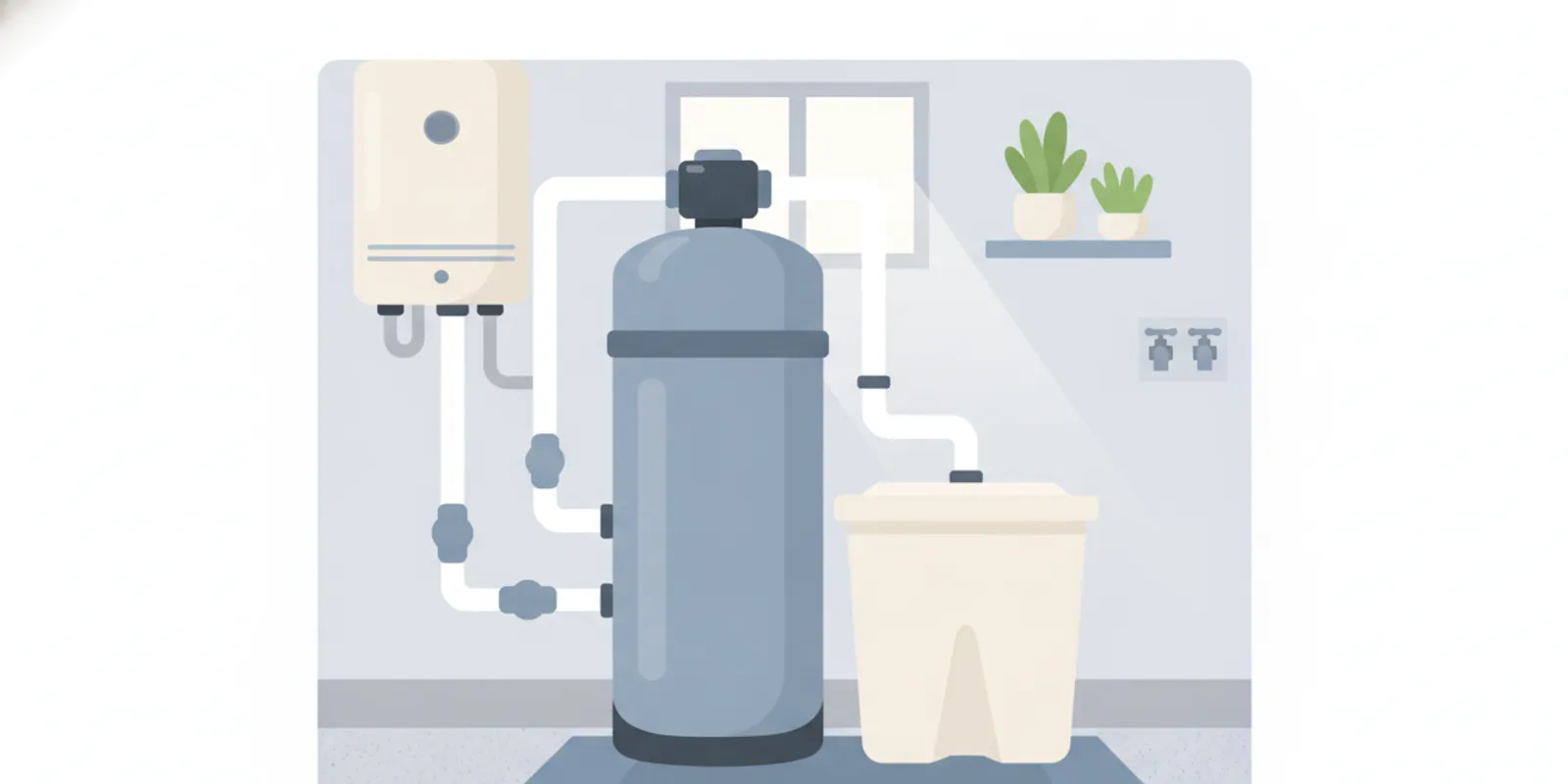
A typical setup includes a mineral tank, a control valve, and a brine tank. The mineral tank houses the resin. The valve directs water through operating and regeneration stages. The brine tank stores salt and water used to make a concentrated salt solution for resin cleaning.
Some models combine components or use different layouts, so the owner’s manual is the best reference for the actual equipment in your home. The unit also needs suitable connections, a place for regeneration discharge, and room for routine access. Those practical details matter when considering a location in a garage or utility area.
- Mineral tank: Holds the resin through which treatment water flows.
- Control valve: Routes water and manages the regeneration sequence.
- Brine tank: Supplies salt solution when the resin needs restoration.
- Drain connection: Carries rinse water and displaced minerals away during regeneration.
The brine tank does not soften each gallon directly. Instead, its salt supports the cleaning cycle that returns the resin toward its working condition. If the brine tank is empty, bridged, or otherwise not functioning as the manual expects, regeneration may not occur as intended.
What happens during regeneration?
Regeneration takes place after the resin has used a portion of its capacity. Exact stages vary by model, but a typical cycle may include backwashing, drawing brine through the resin, rinsing, and refilling the brine tank. The control may start the process at a set time or use estimated water consumption to decide when capacity is running low.
- Backwash: Water flows through the resin bed in reverse to loosen material and prepare the bed for cleaning.
- Brine draw: Salt solution passes through the resin and helps displace collected calcium and magnesium ions.
- Rinse: Fresh water flushes remaining brine and displaced material toward the drain.
- Brine refill: The system adds water to the brine tank so solution can be made for a later cycle.
During some cycles, the unit may temporarily use water for regeneration rather than supplying treated water to the home. The timing and duration depend on the model and its settings. Consult the manual before interpreting a sound, display indicator, or pause in normal operation as a fault.
Demand-based controls can reduce unnecessary cycling when configured properly, but they still depend on accurate settings. Water hardness, household use, and the unit’s capacity all affect how often regeneration is needed. A setting copied from another home may not suit yours.
What changes in softened water?
Ion exchange reduces calcium and magnesium hardness. It does not automatically address every water-quality concern. It should not be treated as a substitute for a filter designed for a particular substance or for a disinfection method.
The exchange process releases sodium or potassium ions into the treated water. The amount depends on the water conditions and equipment operation. Anyone with a health-related dietary restriction should ask a clinician about drinking softened water rather than relying on a general rule.
Where the goal is different from hardness reduction, compare a system designed for that goal. Miranda’s water filtration installation information can help frame questions about filtration, but the exact equipment and its stated capabilities should be reviewed for your water concern.
How can you determine whether treatment is needed?
Start by describing the issue precisely. Scale around an aerator, spots on dishes, or soap that seems difficult to rinse can be clues associated with hard water. These observations do not measure hardness or identify the cause with certainty. Other water conditions and plumbing issues may look similar.
A useful next step is to find out what water source serves the home and whether a reliable test or existing report addresses hardness. If you use a private well, its water may differ from a neighboring home. If the home receives public water, the source and treatment history may still not answer every household-specific question. Avoid assuming that a generalized description of Florida water applies to every address.
Keep a short record before buying equipment. Note where deposits appear, whether they recur after cleaning, which fixtures are affected, and whether the concern is limited to one tap or appears throughout the home. This record helps separate a broad water condition from a localized fixture issue.
- Write down the symptoms and locations rather than relying on memory.
- Check available water information and identify what it does and does not measure.
- Ask what test can confirm the condition you want to address.
- Match the proposed system’s documented purpose to the confirmed concern.
If the evidence points to a localized plumbing problem rather than a whole-home water condition, a softener may not solve it. Miranda provides water leak detection and repair for homeowners investigating suspected leaks.
How can a homeowner check a softener safely?
Begin with a visual check and the manufacturer’s instructions. You do not need to open the control valve or handle internal parts to gather useful information. Record the model, display messages, salt level, and any change in the symptoms that prompted the installation.
- Read the display: Note an error code exactly as shown, then look it up in the manual.
- Check the bypass position: Confirm the valve is in its normal operating position, if the model has an accessible bypass.
- Inspect the salt level: Follow the manual’s guidance on how much salt should be present and which type to use.
- Look for a bridge: A hard crust can form above the water and leave a hollow space beneath it, preventing salt from dissolving normally.
- Look for visible leaks: Check around accessible connections and the floor, without disconnecting hoses or covers.
- Record patterns: Note whether the issue began after a power interruption, a refill, or a change in water use.
Do not change capacity settings, move a drain line, add cleaners, or dismantle the valve unless the manual directs you and you understand the procedure. A mistaken adjustment can make the system perform differently and obscure the original problem. If the system shows repeated errors or water appears near the equipment, seek qualified help.
What routine care does the system need?
Care depends on the model, water conditions, and how much water the household uses. The manual should guide salt choice, refill practices, cleaning, and any service interval. A calendar reminder can help with simple checks, but the schedule should reflect the manufacturer’s instructions rather than an assumed universal frequency.
- Check salt periodically and replenish it with the specified product.
- Keep the tank lid and surrounding area clean and accessible.
- Look for bridging or salt that has hardened into a mass.
- Watch for leaks, unusual sounds, recurring error messages, or unexpected changes in performance.
- Keep the model information and manual where household members can find them.
Salt use is not a reliable measure of performance by itself. Consumption can vary with settings, water hardness, household demand, and the design of the unit. If salt disappears much faster than expected, or the system cycles unusually often, note the pattern and have the settings reviewed instead of making repeated changes by trial and error.
Likewise, adding more salt will not necessarily resolve a system that is not regenerating. A bridge, control issue, bypass position, or other condition may be involved. The visual check can identify what to report, but it does not replace diagnosis when a problem persists.
What should households with septic systems consider?
Homes with onsite wastewater treatment should ask where regeneration discharge goes and how the softener fits the existing arrangement. The Water Quality Research Foundation describes a study that investigated the effects home ion-exchange softeners may have on onsite septic tanks. Its overview is available in Water Softeners and Septic Systems.
The study description is a reason to ask informed questions, not proof that every softener harms every septic system. The right discussion depends on the equipment, discharge routing, and onsite system. Do not redirect discharge or alter plumbing without confirming the manufacturer’s instructions and applicable requirements.
Before installation, ask the installer to explain the planned discharge route in plain language. If you are unsure whether a local requirement applies, verify it with the relevant authority rather than relying on informal advice. Include the septic professional where appropriate, especially if the proposed installation changes an existing discharge arrangement.
Which treatment approach fits the concern?
The first question is not which product has the most features. It is what condition you want to address. This comparison is a starting point; confirm the water condition and review the exact product’s specifications before deciding.
| Approach | Primary purpose | Questions to ask | Routine considerations |
|---|---|---|---|
| Ion-exchange softener | Reduce calcium and magnesium hardness | What capacity and regeneration control suit the household? | Salt, settings, regeneration discharge, and manual-directed care |
| Targeted filtration | Address substances identified by the filter’s design | What exact reduction claims apply to this model? | Filter replacement and performance checks specified by the manufacturer |
| No added treatment | Keep the current plumbing setup | Has a treatment need been established? | Continue observing the concern and seek testing if it persists |
A filter is not automatically a softener, and a softener is not automatically a filter. Some households may have more than one water concern, while others may not need added equipment. Ask for each proposed component’s purpose and limitations separately.
For a water-treatment discussion, see Miranda’s water softener system service information. For broader plumbing questions, use the plumbing services overview.
What should you ask before installation?
A clear recommendation should connect the observed concern to the system being proposed. Ask the provider to explain the test or evidence behind the recommendation and to distinguish hardness treatment from filtration. If an answer relies only on a general statement about local water, ask what applies to your home specifically.
- What condition is this system meant to address, and how was it confirmed?
- What capacity and control settings fit the household’s expected use?
- How will the equipment connect to the existing plumbing?
- Where will regeneration discharge go, and what should septic owners verify?
- Which salt or other consumables does the manual specify?
- What checks can the homeowner perform, and what should be left to a technician?
- How will you tell whether the system is achieving its stated purpose?
- What signs mean the unit needs service rather than another refill or setting change?
Also ask what the system does not do. A careful explanation should not imply that hardness reduction addresses unrelated taste, odor, or safety concerns. A written model name and manual make future maintenance and service conversations more precise.
Homeowners looking at plumbing work can review the available water filtration service details and compare them with the goal they have identified. Call Miranda Plumbing and Air has served homeowners since 1981. Plumbing License CFC1427227; HVAC License CAC1815486.
Contact Call Miranda Plumbing and Air to discuss your water-treatment questions
Frequently asked questions
Does a water softener remove all minerals?
No. An ion-exchange softener is designed to reduce hardness minerals such as calcium and magnesium. It does not remove every mineral or serve as a general-purpose purifier.
Does softened water contain salt?
The process exchanges hardness ions for sodium or potassium ions. The resulting amount depends on water conditions and system operation. Ask a clinician about personal dietary concerns.
How often should a water softener regenerate?
There is no single interval for every home. Some controls use a schedule, while others estimate demand. Follow the manual and ask for a settings check if cycling seems unusually frequent.
Can I add salt without checking the system?
Check the manual for the correct salt and refill guidance. If salt is present but the unit does not seem to use it normally, look for a visible bridge and consult the instructions before making changes.
Does a softener fix spots on dishes?
It may help when hardness is the cause, but spots alone do not establish that diagnosis. Confirm the water concern before treating the whole home.
What is the next step?
A water softener works by exchanging hardness minerals on resin and periodically restoring that resin through regeneration. Confirm the concern, understand the equipment’s limits, and follow its manual so any treatment choice fits your home’s plumbing and wastewater setup.
Need plumbing or HVAC service on the Treasure Coast?
Contact Miranda Plumbing & Air