
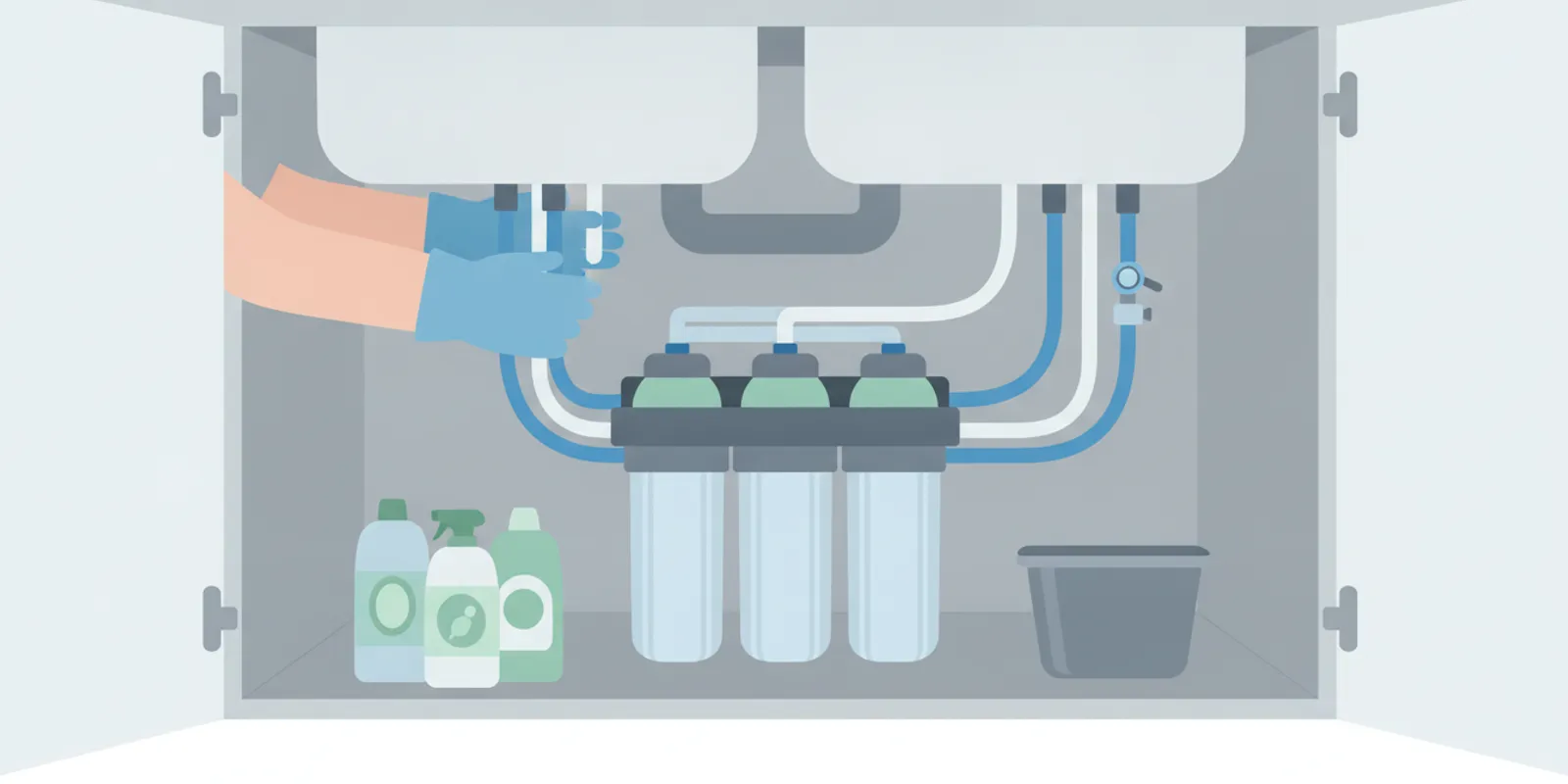
Best under sink water filter: Features to Compare
Choosing the best under sink water filter starts with a simple question: what do you want the water to taste or test differently? Systems vary in what they reduce, how they connect, and how often they need service. A thoughtful comparison can help you avoid paying for features that do not match your household’s needs.
Talk with a plumbing professional
Before comparing brands, identify your water source and concern. A filter selected for taste may not address a different contaminant. The right choice depends on the product’s verified reduction claims, your sink cabinet, household water use, and willingness to maintain it.
What Should You Decide Before Comparing Under-Sink Filters?
Start by separating a water-quality concern from a preference. Unpleasant taste or odor may lead you to explore one type of filter. A specific test result calls for a product that explicitly addresses that substance.
- Write down the concern. Note whether the issue is taste, odor, visible particles, or a reported test result.
- Identify your water source. Determine whether the home uses a public water supply or a private well. The appropriate next step may differ.
- Check available water information. Review your supplier’s current water-quality information when applicable. For a well or a specific concern, consider suitable testing before choosing equipment.
- Set practical limits. Measure cabinet space, note the number of people using the tap, and decide how much maintenance you can manage.
Do not assume one filter treats every possible issue. Read the performance information for the exact model, not just the product family or a broad phrase on packaging. Look for the specific reduction claim and the conditions behind it.
For a professional assessment of plumbing options, see the plumbing services available to homeowners. If you already know the concern involves filtration equipment, review the company’s water filtration installation service as one possible next step.
Which Filter Type Fits Your Water and Routine?
Under-sink products use different treatment approaches. Some combine multiple stages. The names alone do not tell you which substances a system reduces, so confirm model-specific performance information before buying.
| System type | What to compare | Useful questions |
|---|---|---|
| Carbon filter | Specific reduction claims, cartridge availability, and capacity | Does this exact model address my concern? |
| Reverse osmosis system | Performance claims, plumbing connections, storage needs, and upkeep | Will the unit fit, and does installation require a drain connection? |
| Multi-stage system | What each stage does and which claims apply to the complete system | Are stages replaceable, and what does each replacement involve? |
| Simple sediment filter | Particle-size claims, flow, and the reason for installing it | Is sediment the issue I am trying to address? |
This table is a starting point, not a product ranking. Two systems with similar labels can have different claims, capacities, maintenance schedules, and installation requirements. Compare the specifications for the complete model you plan to purchase.
How Can You Build a Fair Comparison?
Use the same checklist for every product. Record the model number, treatment approach, verified claims, required space, and replacement parts. This keeps a persuasive package label from outweighing practical details.
Separate what the system promises from what your household needs. One model may offer more stages, while another may be simpler to maintain. Extra components are not automatically useful if they do not match your water concern.
Check the full system’s instructions rather than relying on a retailer’s short product summary. Confirm whether the listed performance applies to the filter alone or to a particular configuration. Note any installation conditions that could affect a fit beneath your sink.
Then compare upkeep in a way you can sustain. A cartridge that is difficult to source or access can complicate regular maintenance. If two options appear similar, ask the manufacturer to explain the difference in claims, replacement parts, and required connections before choosing.
Reverse osmosis products often involve more components than a basic cartridge filter. Check the manufacturer’s installation instructions for connections, space, and any storage tank. Do not assume every model requires the same setup.
A carbon stage may be part of a single-filter product or a larger combination system. Verify which substances the manufacturer says the particular configuration reduces. Replacing one cartridge with a similar-looking part does not confirm that the replacement has the same performance.
How Can You Match a Product to a Specific Water Concern?
Turn the concern into a question that can be checked against product documentation. For example, “I want better-tasting water” is a preference, while “my test reported a particular substance” calls for a specific performance claim.
If taste or odor is your main concern, look for documentation that names the relevant water characteristics. Do not treat a general “improves taste” statement as proof of broad contaminant reduction. Read the limitations and conditions provided for that exact product.
If you have a test result, write down the substance and the result before shopping. Then search the product documentation for that specific term. If the documentation does not clearly address it, the system may not be a suitable answer to the concern.
Households can also have more than one priority. One person may focus on taste, while another wants an easy cartridge change or enough flow for everyday drinking and cooking. Rank those needs before comparing products, then identify which requirements are essential and which are preferences.
Consider how the filtered tap will be used. A household that fills bottles and pots throughout the day may value convenient access and an adequate stated capacity. A household using the filtered water occasionally may prioritize a compact unit or simple service routine. Use the product’s stated specifications rather than guessing from its size.
For homes with a private well, do not assume that a product designed around a common municipal-water concern will address the well’s conditions. Use appropriate testing and match any equipment to the findings. If results are unclear, ask a qualified water professional or the product maker for help interpreting the product’s limits.
How Can You Verify a Filter’s Performance Claims?
Find the performance data for the model number you are considering. Read the details for the specific contaminant or property you care about. A general statement such as “improves water” is not enough to establish that the product suits your need.
Look for independent certification information when relevant. Check the certifying body’s listing or the product documentation, and confirm that the exact model and claimed reduction are covered. A logo alone does not tell you every performance detail.
Consumer Reports compares under-sink water filters using factors such as features and performance. Its under-sink water filter ratings and reviews can be one research source. Check the product’s own current documentation as well, since model details and replacement parts can change.
Keep these checks together before purchasing:
- Does the documentation name the exact model?
- Does it identify the specific substances or qualities addressed?
- Are test conditions and performance limits explained?
- Is the claim backed by a recognized, verifiable certification where applicable?
- Can you obtain the correct replacement cartridge when needed?
If water testing identified a particular issue, match the result to a clearly documented reduction claim. Ask the product maker or a qualified water professional to explain any uncertainty. Do not rely on a broad claim that does not address your test result directly.
What Does a Model-Specific Check Look Like?
Imagine two products both described as multi-stage filters. One product sheet may explain each stage and list a verified reduction claim for the full configuration. The other may only describe the number of stages and use broad benefit language.
Those descriptions do not give you equal evidence. Record the model number and the exact claim for each product. Check that the claim refers to the system as sold, including its included cartridges and configuration.
Also check the replacement cartridge number. Confirm that the replacement part is listed for the system and that its documentation supports the performance you expect. A compatible-looking cartridge is not necessarily an equivalent replacement.
When the paperwork uses unfamiliar language, ask the manufacturer to explain the claim and its limits in plain terms. Keep the answer with the model information. If an important performance question remains unanswered, compare another product rather than filling in the gap yourself.
What Installation Details Matter Under the Sink?
Measure the cabinet before ordering. Include the space needed to install the filter, reach shutoff valves, change cartridges, and keep stored items clear. A unit that technically fits can still be difficult to maintain if its service area is blocked.
Check whether the system uses the existing faucet or includes a separate drinking-water faucet. A separate faucet may require a suitable opening. Confirm what the product instructions require before drilling or modifying a sink or countertop.
Review the connection requirements. Some systems connect to the cold-water supply. Others may need additional tubing, a drain connection, or a storage tank. The exact requirements depend on the product and existing plumbing.
Look closely at how replacement cartridges are accessed. If the unit sits behind stored supplies, routine service may become frustrating. Make sure the installation leaves room to shut off water and reach the components safely.
Take measurements in more than one direction. Cabinet interiors can have a disposal, pull-out shelf, plumbing lines, or a drawer above that limits usable height. Note the location of the cold-water shutoff and existing drain connections. Compare those details with the installation diagram, not just the housing dimensions.
Think through the cartridge-change motion before selecting a location. Some housings need clearance below them for a filter to twist out or drop down. A system can fit on installation day but become awkward if a shelf or stored item blocks later service.
Homeowners in the area can check local service information for Fort Pierce, Stuart, and Vero Beach. Service availability depends on the home’s location and the work requested.
What Should You Check Before Scheduling Installation?
Gather the product model, installation manual, and a few clear cabinet measurements. Note whether you want to keep the existing faucet or add a separate one. This makes it easier to spot a mismatch before work begins.
Ask which connections are included in the product instructions and which depend on your existing sink setup. Confirm whether the planned location leaves access to shutoffs and replacement parts. If an opening or drain connection is required, clarify that before buying the system.
Do not cut a countertop or alter plumbing based only on a quick product photo. Follow the manufacturer’s instructions and confirm that the actual sink and cabinet can support the proposed configuration. If anything is uncertain, pause before making a permanent change.
Ask about under-sink filter installation
How Do You Compare Upkeep and Long-Term Practicality?
The purchase price is only one part of owning a filter. Consider the replacement parts, how often the manufacturer says to change them, and how easy it is to find the correct cartridge. Do not use an assumed replacement interval when the model’s instructions provide one.
Compare the following ownership details across your finalists:
- Replacement schedule: Record the manufacturer’s recommended interval or capacity for each stage.
- Replacement cost: Check current prices for genuine compatible cartridges before choosing the system.
- Availability: Confirm that replacement parts are sold through a source you can use reliably.
- Service steps: Find out whether changing a cartridge is a straightforward homeowner task or requires professional help.
- Waste and storage: For systems with additional components, understand their operating requirements and cabinet footprint.
Keep the model name, installation date, and cartridge information in one place. Follow the product instructions, including any flush or reset steps after replacement. If the water flow changes or a leak appears, follow the manufacturer’s guidance and stop using the system if instructed.
A useful comparison is the cost and effort over the period you expect to own the system. Write down the unit price, each cartridge price, the stated replacement interval, and how many different cartridges the system uses. Do not assume the least expensive unit is the least expensive to maintain.
Consider the calendar as well as capacity. A product may give a time-based replacement recommendation, a capacity limit, or both. Follow the manufacturer’s instructions for the model and household conditions. Set a reminder after installation and save the cartridge number where you can find it later.
Ask how the system signals that service is due. Some designs may use a calendar reminder or indicator, while others depend on the owner tracking dates or usage. Do not assume an indicator measures water quality unless the manufacturer says it does.
When installation raises broader plumbing questions, the water filtration installation page explains the service path. The company also provides general plumbing support for homeowners considering work at a sink or supply connection.
What Mistakes Can Make a Filter Purchase a Poor Fit?
Choosing by brand popularity alone can overlook the most important question: whether the specific model addresses your concern. A filter can have attractive features and still be unsuitable for a particular test result or household setup.
- Buying before identifying the goal. Decide whether you want a taste improvement or are responding to a documented water-quality concern.
- Reading only the front of the box. Review detailed performance information for the exact model and configuration.
- Ignoring cabinet access. Consider cartridge changes and shutoff access, not just whether the housing fits.
- Forgetting replacement parts. Confirm part availability and recurring maintenance before selecting a system.
- Assuming all systems work alike. Product types and connection needs vary, so read the installation instructions.
Another common mistake is comparing unlike claims. One manufacturer may list a reduction claim for a particular substance, while another describes a general taste benefit. Put each claim in its own column and compare only like information.
Do not treat the number of filtration stages as a measure of quality by itself. A stage count does not tell you what each part is designed to do or whether the complete system addresses your concern. Look for explicit documentation instead.
Do not overlook replacement compatibility. Some systems have multiple cartridges with different schedules. Confirm the right part numbers and availability before purchase, then save those details with the manual.
For a new concern or an unexplained change in water, avoid guessing from taste or appearance alone. Use appropriate information or testing to clarify the issue. Then compare solutions with claims that address that issue directly.
What Should You Ask Before Choosing the Best Under Sink Water Filter?
Bring a short list of questions when comparing products or discussing installation:
- What specific water concern am I trying to address?
- Which model-specific performance claim matches that concern?
- Can I verify the certification or test information for this exact configuration?
- Will the unit, faucet, tank, and tubing fit the cabinet and sink?
- What parts need replacement, and how will I obtain them?
- What installation work and maintenance steps does the manufacturer require?
Clear answers make it easier to compare options without relying on vague promises. If the product information leaves a key question unanswered, pause and get clarification before purchase.
For help evaluating a plumbing installation at home, contact Call Miranda Plumbing and Air. The company serves residential plumbing customers across the Treasure Coast, including homeowners looking for a practical next step.
Call Miranda Plumbing and Air has served homeowners since 1981. Florida license numbers are CFC1427227 for plumbing and CAC1815486 for HVAC.
Discuss your water filtration questions
Frequently Asked Questions
Does an under-sink filter remove every contaminant?
No single product should be assumed to address every possible contaminant. Check the exact model’s performance information and match its claims to your water concern.
Is reverse osmosis always the best choice?
Not necessarily. Compare its documented performance, connections, space needs, maintenance, and suitability for your specific concern with other system types.
How often should I replace an under-sink filter cartridge?
Follow the manufacturer’s schedule for the exact system and cartridge. Replacement timing can depend on the product and its stated capacity or operating conditions.
Can I install an under-sink filter myself?
Installation requirements vary by product and existing plumbing. Read the instructions carefully, and arrange qualified help if the work involves unfamiliar connections or modifications.
What is the first step if I have a specific water-quality concern?
Identify the concern and consult appropriate water-quality information or testing. Then look for a model with clear, verifiable performance information that addresses it.
Contact Call Miranda Plumbing and Air
Compare the exact claims, fit, and maintenance demands before choosing a system, and seek qualified help when installation questions remain.
Need plumbing or HVAC service on the Treasure Coast?
Contact Miranda Plumbing & Air