
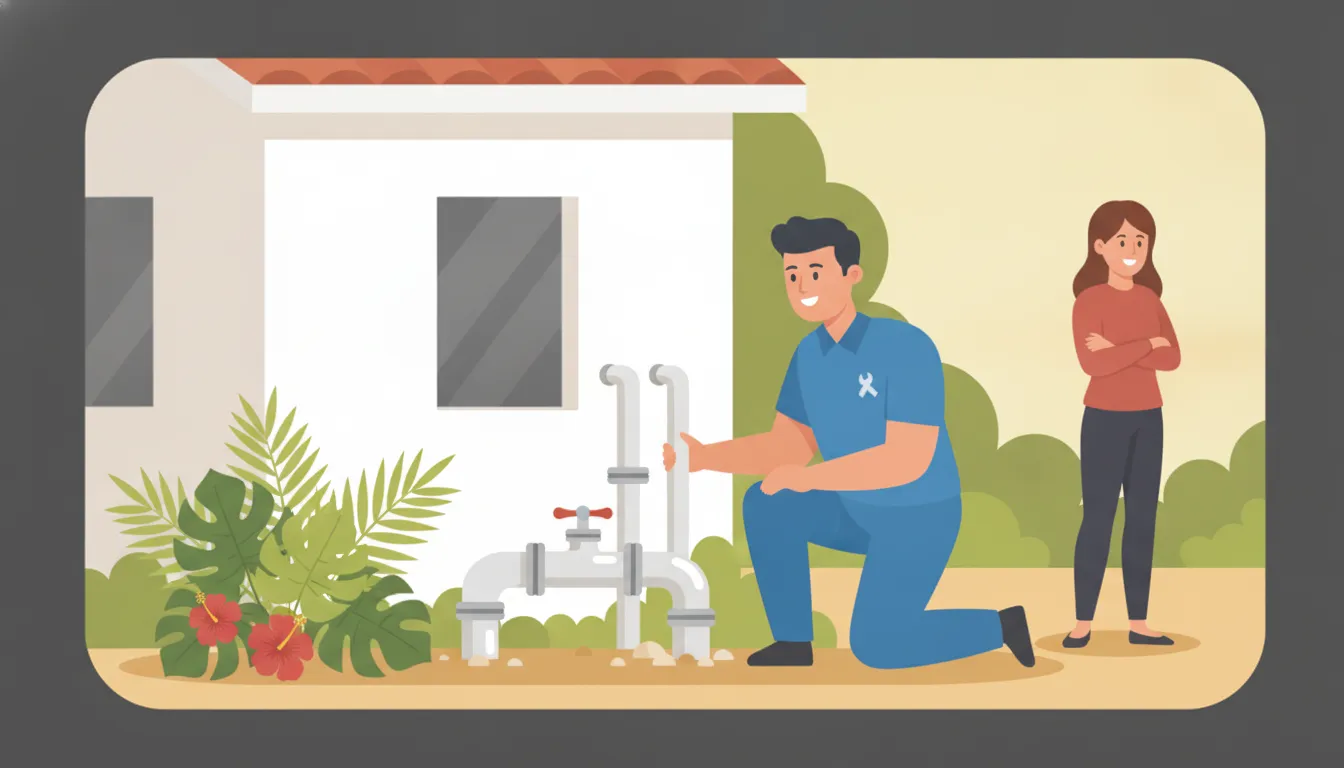
Backflow Prevention: Why Florida Homes May Need It
Your drinking-water plumbing may connect to irrigation or other systems that carry water not meant for drinking. That possibility is worth understanding, but it does not mean your home's water is contaminated. The practical first step is learning how water can move the wrong way and who can confirm local requirements.
Contact Miranda with a plumbing question.
Backflow prevention helps keep nonpotable water from flowing backward into drinking-water plumbing through a cross-connection. Backflow can occur when pressure changes reverse the normal flow, such as through backsiphonage or backpressure. The EPA explains that prevention programs vary by state and municipality. A Treasure Coast homeowner should ask their water provider or local plumbing authority what applies.
To understand why protection may be needed, start with the connection between potable and nonpotable water, and the pressure changes that can send water backward.
What Is Backflow Prevention, and How Does Backflow Happen?
Your home's plumbing is designed to move water in one direction, from the supply toward faucets and other fixtures. Under certain pressure conditions, water can move the other way through a connection between drinking-water plumbing and another water source or system.
Quick definition: Backflow is the unintended reversal of water through a cross-connection. A cross-connection is an actual or potential link between potable water, meaning water intended for drinking, and nonpotable water or plumbing. The U.S. Environmental Protection Agency explains that backflow prevention programs help keep contaminants out of drinking-water systems.
What makes a cross-connection important?
A connection does not mean that a home's water is contaminated. It describes a possible route that could allow water from another plumbing system to flow toward the drinking-water supply if pressure changes. The outcome depends on the specific connection and circumstances.
For example, the EPA identifies private irrigation and fire-sprinkler piping that receives public drinking water as possible cross-connection points. Backflow prevention addresses the potential pathway, rather than diagnosing a problem in any particular home. EPA cross-connection control fact sheet.
How does backsiphonage occur?
Backsiphonage can happen when pressure in the drinking-water supply drops below pressure in connected plumbing. That pressure difference can draw water backward through an unprotected cross-connection.
A drop in supply pressure may occur during a disruption in the distribution system. The EPA describes lower pressure in the public water system than in connected plumbing as a condition under which backflow contamination can occur. This is a general mechanism, not evidence that a specific home has experienced it.
How is backpressure different?
Backpressure occurs when pressure in connected plumbing becomes greater than pressure in the drinking-water supply. Pumps, differences in piping elevation, or heat-related expansion can contribute to higher downstream pressure.
In either situation, the concern is water moving opposite its intended direction through a cross-connection. Backflow-prevention devices or assemblies are selected according to the connection and applicable local requirements. Homeowners should ask their water provider or a qualified plumbing professional about a specific property, rather than choosing or adjusting equipment themselves.
Where Can a Home Cross-Connection Occur?
Irrigation piping
A private irrigation system may connect to the same public drinking-water supply that serves a home. The connection is a potential cross-connection because water in irrigation piping is not managed as drinking water at every point of use.
The U.S. Environmental Protection Agency lists private irrigation systems among piping that can connect to a public water system. That does not mean every irrigation setup is hazardous, contaminated, or subject to the same device requirement. The actual arrangement and applicable local rules matter. EPA's cross-connection fact sheet explains this risk in the context of water-system protection.
Fire sprinkler and other connected piping
Fire sprinkler piping that receives drinking water can also be a possible connection point. The EPA identifies sprinkler systems and other piping supplied by public drinking water as examples. Their presence alone does not establish that backflow has occurred or that a specific assembly is required at every home.
Different systems can have different layouts and uses. A homeowner may not know how a line connects simply by looking at the equipment. A utility, plumbing official, or qualified professional can help determine whether a particular arrangement needs protection under applicable requirements.
Outdoor hose connections
A garden hose is another example of a temporary connection. The EPA lists hose connections and other piping systems among possible cross-connection considerations. A hose used around nonpotable water is worth understanding, but it does not prove contamination has happened.
Do not treat a general example as instructions to choose or install a device. The appropriate protection depends on the connection and local requirements. Ask your water provider or a qualified professional before making changes to plumbing.
It also helps to separate backflow protection from water treatment. A filter addresses water quality through treatment; it does not prevent reverse flow through a cross-connection. Miranda offers whole-home water filtration options, but filtration is not a substitute for backflow protection.
When Might Florida Homeowners Need Backflow Protection?
Requirements depend on the local program
There is no safe basis for assuming every Florida home needs a backflow device or a yearly test. Cross-connection and backflow-prevention programs vary by state and municipality, so the answer can depend on local rules and a property's actual plumbing arrangement. The Florida Department of Environmental Protection's program information offers state-level context, while the U.S. Environmental Protection Agency explains that requirements differ among states and municipalities.
That distinction matters for Treasure Coast homeowners. A general article cannot determine whether a particular address needs an assembly, which type is appropriate, or whether testing is required. Those details should come from the responsible water provider or utility and the local plumbing authority, using the rules that apply to the property.
What property details should you ask about?
When checking requirements, describe the home's water connections rather than relying on a broad rule of thumb. An irrigation system connected to the drinking-water supply, a fire-sprinkler system, or another auxiliary supply may be relevant to a cross-connection review. These features do not, by themselves, prove that a specific device or test is required.
The property's configuration also matters. Ask whether the system draws from the public water supply, uses a separate source, or includes plumbing that could connect those supplies. Explain any recent changes, such as added irrigation or modified piping, and share any written notice you received. EPA identifies private irrigation and fire-sprinkler piping among possible cross-connection concerns, but local officials determine how applicable requirements address a specific setup.
Use the notice and local code to confirm next steps
Start with the water provider or utility serving your address. Ask whether its cross-connection program applies to your property, what device or assembly is required, and which current code or notice governs the answer. The EPA recommends checking with state drinking-water programs, building-code or plumbing authorities, and health departments for local requirements. Its cross-connection control fact sheet also explains why local requirements cannot be treated as universal.
If a notice requests inspection or testing, follow the stated instructions and confirm who is authorized to perform the work. Do not assume an interval based on a neighbor's property or advice from another municipality. If the utility's answer is unclear, ask the local plumbing official to identify the applicable requirement before choosing equipment or arranging work.
| Question | Best starting point | What to confirm |
|---|---|---|
| Does my property need protection? | Water provider or utility | Whether its program covers the address and connected systems. |
| Which rules apply? | Local plumbing authority | The current code, notice, device, and testing requirements. |
| What is connected at my home? | Qualified plumbing professional | How the piping is arranged and whether a cross-connection may exist. |
A qualified plumbing professional can help describe the home's piping and discuss options, but the utility or local authority should confirm what rules apply. This keeps the decision tied to the actual property, rather than an unsupported statewide assumption.
What Signs Could Point to a Water-Quality Problem?
A sudden change in water can be unsettling, but it does not identify the cause. Backflow is one possibility a water provider may investigate, not a conclusion homeowners can reach from a symptom.
The U.S. Environmental Protection Agency lists customer complaints about unusual odor, discoloration, or direct physical harm among the primary indicators utilities consider when assessing a possible backflow incident. Decreased water pressure can also be an indicator. A short-term drop in disinfectant residual may provide another clue for water-system operators.
These are clues for investigation, not a home diagnostic checklist. Pressure changes can have several causes, and residents generally cannot measure disinfectant residual. Water that looks or smells normal is not proof of safety, while an unusual appearance or odor alone does not prove contamination.
EPA also notes that a meter might run in reverse during reversed flow. That observation is relevant to water-system assessment, not a reliable test homeowners should try to perform or interpret.
Utilities can consider reports alongside operational information when deciding whether to investigate a possible incident. A pressure change alone, or a single household complaint, does not establish where a problem began or whether backflow occurred.
When you call, share your service address, when the change started, and whether it affects one tap or several. Mention any odor or visible color change, pressure loss, or symptoms after water use. These details help the provider understand the concern; they do not replace its assessment.
If the provider confirms an advisory, follow its instructions instead of relying on general online advice. If no advisory appears, contact the utility directly when you remain concerned. Different water-quality issues can require different precautions, so do not assume one household treatment method is appropriate.
Notice changes without trying to diagnose them
Pay attention if tap water suddenly changes in color or odor, or if the household experiences an unexpected pressure decrease. Note when the change began, which fixtures are affected, and whether neighbors report a similar issue. Share those observations with the water provider rather than trying to identify a backflow event yourself.
Do not taste water to investigate it. Avoid assuming that boiling, filtering, or running the tap will address an unknown water-quality concern. The right response depends on the situation and on guidance from the responsible utility or health authority.
Contact the water provider and follow its guidance
If you are concerned about a change in water quality, contact your water provider promptly and describe what you observed. Check the provider's official notices for any advisory affecting your address. Follow the specific instructions issued by the utility or public-health authority, including directions about drinking, cooking, or other water uses.
If anyone experiences direct physical harm after using the water, seek appropriate medical help and notify the provider. For a pressure change without an advisory or odor concern, the provider can explain whether it knows of a distribution-system issue and what steps to take next.
The EPA's cross-connection control fact sheet describes the indicators utilities may consider. Its guidance concerns water-system investigation; it does not mean that any single household symptom confirms backflow. For homeowners learning about plumbing services, keep that distinction in mind: observations can prompt a call, while water-quality determinations belong with the provider and relevant authorities.
What Should You Do if You Suspect Backflow?
A change in taste, odor, color, or pressure can have several causes. It does not confirm backflow or prove that water is contaminated. Treat a sudden change or water-quality advisory as a reason to get guidance promptly.
The following are practical precautions for homeowners, not direct instructions quoted from the EPA.
Start with the water provider
Contact your water utility or provider promptly. Describe the change or advisory and ask whether it affects your address. The EPA identifies odor complaints and discolored water as indicators utilities consider when assessing a possible incident, not as a homeowner diagnosis. Read the EPA cross-connection control factsheet.
Follow its guidance and record details
Follow the provider's directions about drinking and cooking. If it advises against using tap water for those purposes, follow that instruction until it gives an update. Do not rely on appearance or smell alone to decide that water is safe.
Note when the change began, which faucets or areas are affected, any pressure changes, and whether you received an advisory. Share these observations with the utility. They can help staff assess the concern without treating a single symptom as proof.
Do not handle a backflow assembly. Do not touch, test, adjust, remove, or bypass it. Leave inspection and corrective work to qualified personnel who can identify the equipment and applicable requirements.
Ask a qualified professional about the property
After contacting the provider, ask a qualified plumbing professional to assess whether a property-side cross-connection or assembly may be involved. The provider or local plumbing authority can clarify applicable requirements and next steps.
The EPA factsheet describes corrective measures such as eliminating a cross-connection or installing an assembly that meets applicable state and local requirements. It also says customers should understand their responsibilities for assemblies, including testing and repair. Those responsibilities do not make homeowner testing or adjustment appropriate. EPA cross-connection control factsheet.
Explore Miranda's plumbing services
How Can a Plumber Help Protect a Home's Water Supply?
Assess possible cross-connections
A qualified plumbing professional can review how household plumbing is configured and look for possible connections between drinking-water lines and systems carrying nonpotable water. Irrigation and other piping connected to a public supply can raise cross-connection concerns, but their presence alone does not mean every home needs a device or violates code.
An assessment can also consider whether an existing assembly appears damaged, improperly configured, or inconsistent with the property's use. A homeowner's visual impression cannot confirm that a device is suitable or working correctly. If you are unsure what is installed, ask a qualified professional rather than opening, adjusting, or testing the assembly yourself.
Confirm local requirements before choosing equipment
Device selection depends on the application and the rules that apply locally. The EPA explains that cross-connection and backflow-prevention programs vary by state and municipality. Local codes or regulations determine which assemblies apply to particular uses, so a professional should not guess based on another property's setup.
For a specific property, check with the water provider or utility and the local plumbing authority. They can clarify whether protection, inspection, or testing is required and what approved equipment or procedures apply. Florida's statewide drinking-water program provides context, but it does not establish that every home has the same requirements.
Use qualified help for required work
If the authority requires an assembly, installation and any required testing should be handled by appropriately qualified personnel under applicable local guidance. The EPA describes prevention measures as eliminating a cross-connection or installing an assembly or device that meets state and local requirements. Requirements can depend on the situation, so confirm responsibilities and any testing schedule with the authority instead of assuming a universal interval.
Contact Miranda with a general plumbing question.
Miranda lists backflow prevention among its commercial plumbing services. That page describes commercial work; it is not a promise of specialized residential backflow testing or repair. For general household plumbing questions, review Miranda's plumbing services or contact the company to ask what support is available.
Frequently Asked Questions About Backflow Prevention
Does every house need a backflow preventer?
No. Whether a home needs a backflow-prevention device depends on the property's plumbing, potential cross-connections, and applicable utility or local requirements. Ask your water provider or local plumbing authority before deciding.
Where might a backflow preventer be required?
Requirements vary by state and municipality. A water provider or local plumbing official can explain whether a specific irrigation connection, auxiliary supply, or other plumbing arrangement needs protection.
How can I tell whether my house has a backflow preventer?
A homeowner may notice a device near an irrigation or water-service connection, but appearance alone does not confirm its purpose or condition. Ask a qualified plumbing professional or your water provider to identify it.
Do you need a plumber to install a backflow preventer?
Device selection and installation should follow local requirements and the water provider's instructions. Contact the provider or a qualified plumbing professional rather than choosing or changing an assembly yourself.
Get a Clear Next Step for Your Home
If you have questions about plumbing connections or an unusual water-quality change, start with the right source.
Your utility or local plumbing authority can clarify applicable requirements. A qualified plumbing professional can assess your home's plumbing and explain what work may be appropriate.
Miranda Home Services serves homeowners across Florida's Treasure Coast with licensed plumbing expertise. The team can help you identify a suitable next step and direct you to the appropriate source for backflow-specific requirements.
Contact Miranda Plumbing & Air to discuss your plumbing concern.
Need plumbing or HVAC service on the Treasure Coast?
Contact Miranda Plumbing & Air